🎁  Buying this as a gift? Give the gift of belonging to an ancient Irish clan — signed by the Chief, posted worldwide.

Gift a membership →
Join the clan → 🎁 Gift a clan membership →
Documented pedigree & history

History of Clan Ó Comáin

From Bronze Age Ireland to the present day

Chapter I

Ancient origins

4,000 years in Ireland

The Commane family's presence in Ireland is not measured in centuries but in millennia. Big-Y DNA testing confirms the direct male line of the family carries haplogroup R-L21 — the defining genetic marker of the Celtic peoples of Ireland, Scotland, Wales and Brittany — placing their male ancestry within the Bronze Age population that settled the western edge of Ireland over 4,000 years ago.1

The family's specific haplogroup, R-L1066, has been identified in ancient remains from Scotland dating to 1500–1300 BC, with a further ancient individual carrying a closely related branch identified between 43 BC and 117 AD — reflecting the shared ancestry of the Atlantic Celtic world at a time when Ireland and Scotland were effectively one people.2

The terminal haplogroup R-BY14247 is found in Ireland and connects to a single confirmed living DNA match — Cornelius Moylan, an Irish surname from Clare and Munster — representing the most promising living genealogical lead for connecting the modern Commane family to its medieval Clare ancestors across the documentary gap of the 13th to 17th centuries.3

The result also sits within the R-Z2534 branch shared by the ancestors of the Dál Cais dynasty of Clare — the family of Brian Boru, and the O'Brien, MacNamara and O'Dea lords who governed the region for centuries — suggesting that at a deep prehistoric level, these great Clare families and the Commanes descend from the same ancient ancestors.4

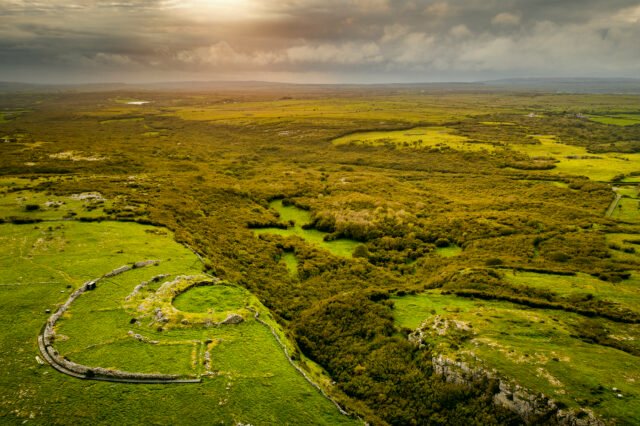
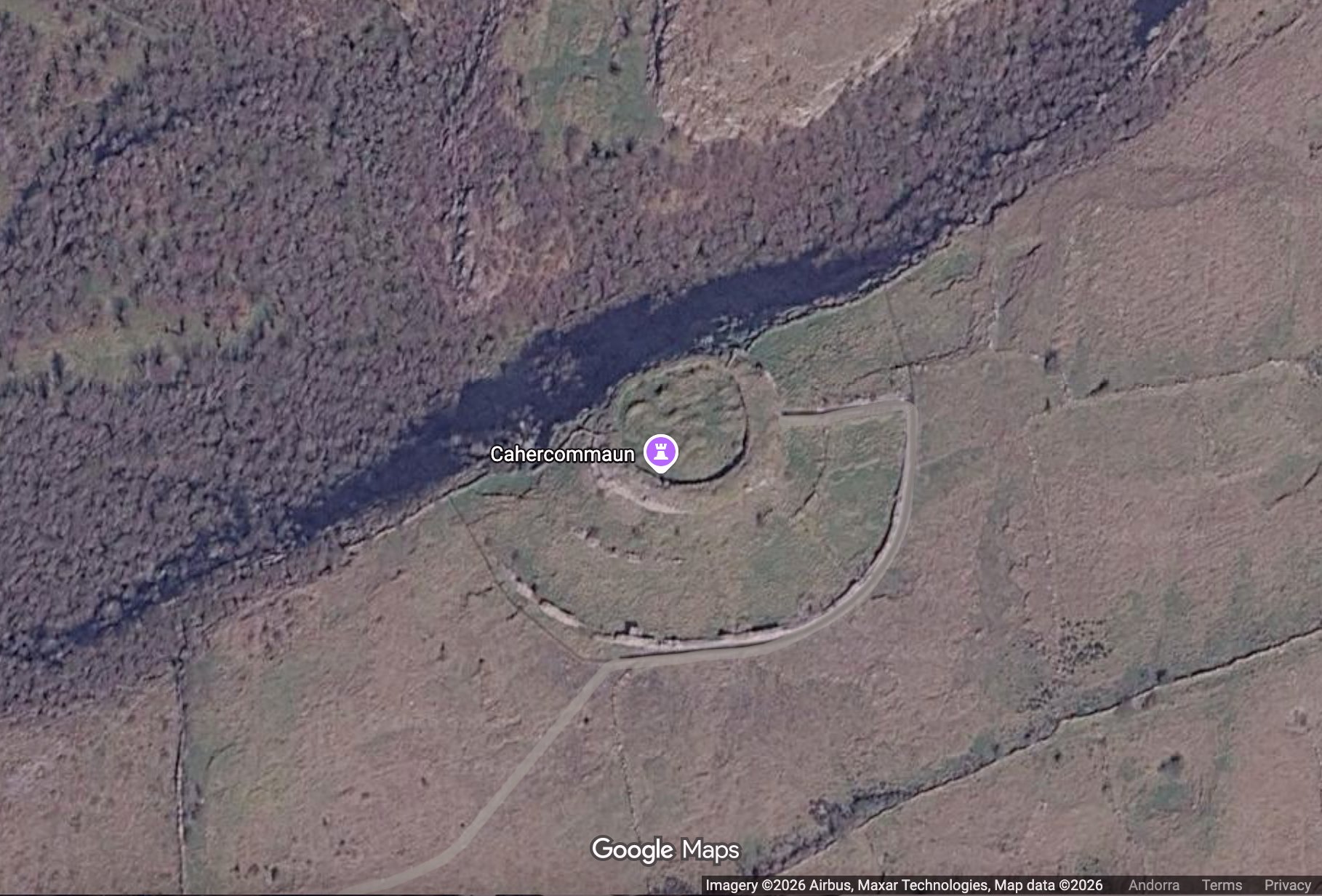
Aerial view of Cahercommane — the Burren, County Clare
Cahercommane — the ancestral capital of the Chiefdom of Tulach Commáin
Chapter II

The royal pedigree

Kings of Uí Maine — the Connacht royal line

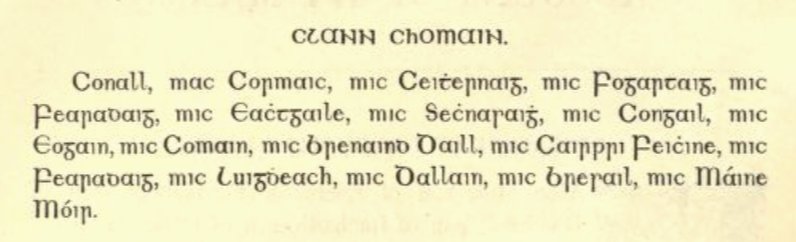
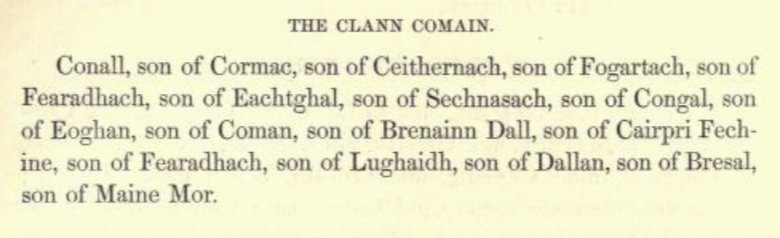
The O'Hart pedigree, recorded from the Book of Lecan and Book of Leinster — two of the great medieval manuscript compilations of Irish genealogy — traces the Commane family's documented royal descent through the kings of Uí Maine in Connacht.5

The Kingdom of Uí Maine was established by Máine Mór mac Eochaidh around 357 AD, centred on what is now east Galway and south Roscommon. It became one of the most important provincial kingdoms of medieval Connacht, producing a remarkable number of the great Gaelic dynasties of the west of Ireland.6

Cairbre Crom, 11th King of Uí Maine (fl. c. 556 AD), is the critical ancestral figure from whom almost all subsequent Uí Maine dynasties descend. Through Cairbre Crom, the Commane family shares common ancestry with the Clancy, Kelly, Madden, Tracy, Hannan, Kenny, Colman, Egan and Larkin families — many of the great Gaelic dynasties of Clare and Connacht.7

Breanan Dall, 12th King of Uí Maine, whose death is recorded in the Annals of Ulster at 597 or 601 AD, is the earliest individually named direct ancestor of the Commane family documented in a primary historical source.8 He is the father of Coman, from whom the surname Ó Comáin directly derives.

Coman mac Breanan Dall (fl. 620–650 AD) is the name-giver of the entire family — the original Ó Comáin, "descendant of Coman," from whom all subsequent generations of the clan descend.

The last recorded head of the family in the O'Hart pedigree is Conall O'Comain, noted at the time of the Anglo-Norman dispossession in 1225 — after which the family lost territorial authority but the name continued through the subsequent centuries.

Pedigree extract
Máine Mór mac Eochaidh (c. 357 AD)

...Kings of Uí Maine...

Cairbre Crom (fl. 556 AD)

Breanan Dall (d. 597/601 AD)

Coman mac Breanan Dall

...generations...

Conall O'Comain (1225)
Source: O'Hart, Irish Pedigrees (1892), from Book of Lecan and Book of Leinster
Chapter III

Kings of Déisi Munster

The Munster royal line and the coming to Clare

Alongside the Connacht royal pedigree, the medieval Irish annals record a parallel tradition of the Comáin name in Munster — specifically in the Déisi, a people who were settled across parts of Munster under the overlordship of the Eóganacht kings of Cashel.

Suibne mac Comáin, rí na nDéisi — king of the Déisi

Annals of Ulster, 658 AD

Suibne mac Comáin, who died in 658 AD, is recorded in the annals as king of the Déisi Munster — one of the earliest historical figures bearing the Comáin name in any primary source.9 His son Congal mac Suibne, who died in 701 AD, is also named in the Annals of Ulster as king of the Déisi.10

Célechair mac Commáin was killed at the battle of Corcu Modruad in 705 AD — one of a series of 8th-century battles fought for domination of north Clare. Cotter (2012, p.87) establishes from the medieval Irish genealogical tracts that Célechair belonged to the Uí Chormaic, a third branch of the powerful Uí Fidgeinti of north Munster. His presence fighting for control of north Clare — the territory of the Chiefdom of Tulach Commáin — provides the earliest evidence connecting the Commáin name to a Uí Fidgeinti sub-royal line active in this landscape.11

Colmán mac Commáin, possibly Célechair's brother despite 46 years between their deaths, died on the Aran Islands in 751 AD (Annals of Inisfallen). He is commemorated in the martyrology Félire Óengusso and described in Leabhar Breac as a bishop of Munster and one of the four sages of Ireland. The co-occurrence of a warrior and a bishop-sage bearing the Commáin name in the same generation and territory is the clearest evidence of the family's prominence in early medieval north Munster and Clare.11

The annalistic evidence from the Dessi Genealogies, written in the Book of Lecan, Rawlinson B 502, and the Book of Leinster, establishes the family's presence across both the Connacht and Munster traditions from the earliest recorded period.12 Whether these represent one family or two independent lines sharing the personal name Comáin remains an open scholarly question — both traditions are presented here honestly.

Archaeologist Claire Cotter suggests that the Burren area may have been named after a sub-king named Commán, noting evidence in the annals — including the Annals of Ulster recording the 744 AD destruction of Corcu Mruad by the Déisi — consistent with Gibson's analysis of the chiefdom.13

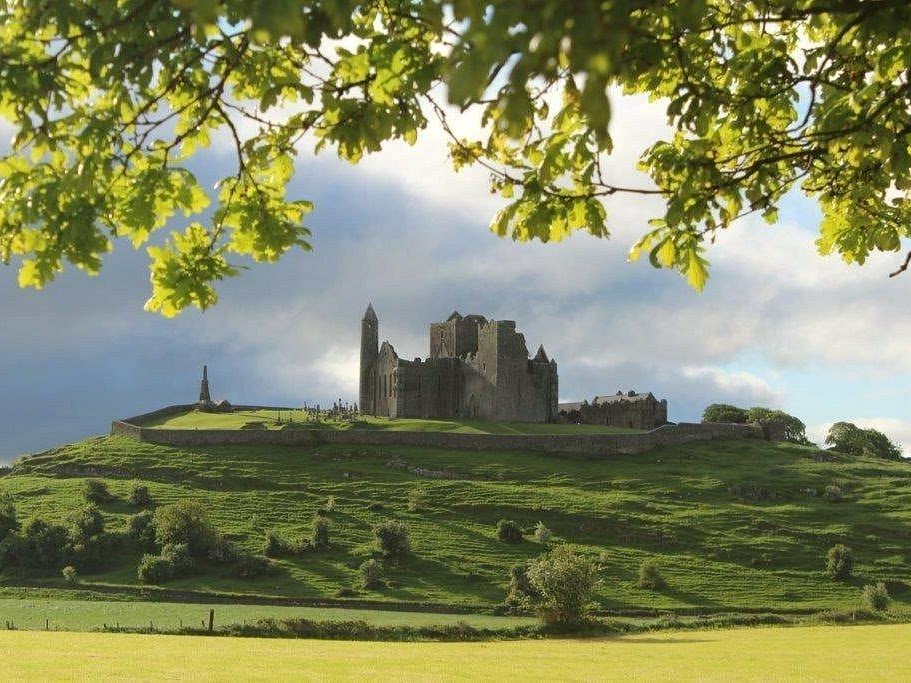
Rock of Cashel — seat of the Eóganacht, County Tipperary
Rock of Cashel, St Patrick's Rock — seat of the Eóganacht, overlords of the Déisi Munster. The Chiefdom of Tulach Commáin was probably a vassal of the Kingdom of Cashel according to historians.
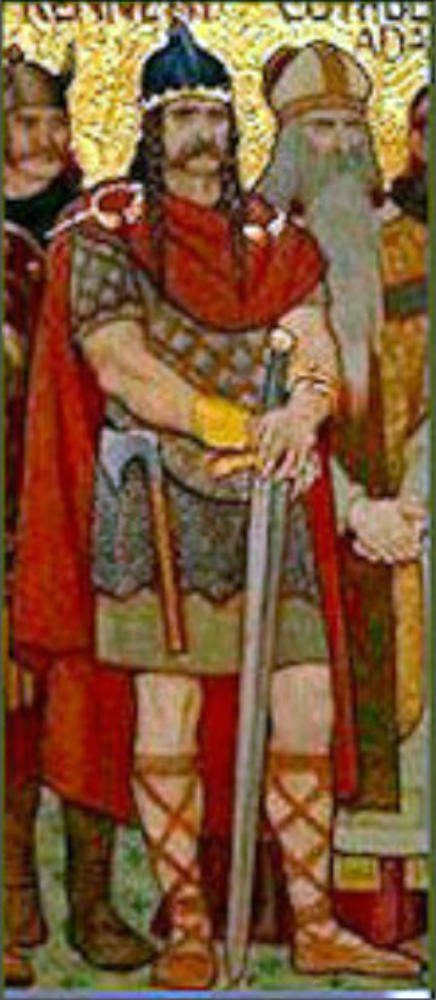
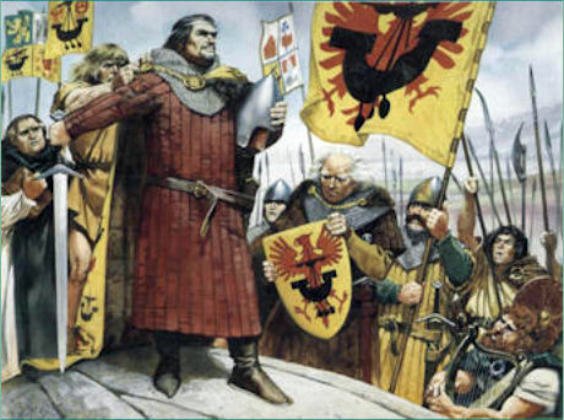
Early Irish king — Gaelic warrior nobility
A Gaelic king of the early medieval period — the world of Suibne mac Comáin, king of the Déisi Munster, 658 AD
Chapter IV

Saints and scholars

The ecclesiastical heritage of the Comáin name

Saint Commán founded Roscommon — Ros Commáin, meaning "Commán's Wood" — and the ancient church at Kinvara in County Galway, on the southern edge of the Burren. His death is recorded in the Annals of Ulster at 747 AD.14 The Dictionary of National Biography (1887) is explicit that these are one and the same person — the entry states that Saint Commán of Roscommon "also founded the church of Ceann Mara, now Kinvara" — placing both foundations with a single saint whose ministry extended from Roscommon to the shores of the Burren.15

Kinvara sits directly on the southern shore of the Burren — the very heartland of the ancient Chiefdom of Tulach Commáin — placing the saint's foundation within sight of the ancestral capital Cahercommane. Roscommon town and county bear the saint's name to this day, making Saint Commán one of the most geographically enduring of all Irish saints.

Colmán mac Comáin, whose death on the Aran Islands is recorded in the Annals of Inisfallen at 751 AD, is called one of the four sages of Ireland — a remarkable designation placing a member of the Comáin family among the great learned men of early medieval Ireland.16

Gilla Cómáin mac Gilla Samthainde (fl. c. 1072 AD) was a celebrated medieval Irish poet whose works were incorporated into the Lebor Gabála Érenn — the Book of Invasions — one of the great manuscripts of Irish literature.17

The family name is also preserved in Ferchess mac Commán — a fian warrior and poet in early Irish mythology, a member of the household of King Ailill who ruled southern Ireland, recorded in the ancient sagas as having avenged the death of Ailill's son.18

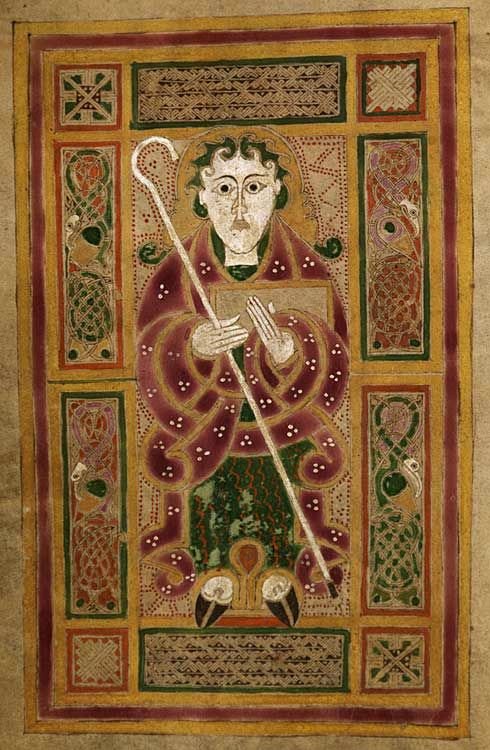
Early Irish saint — 9th century Irish manuscript illumination in the insular tradition
Saint in the insular manuscript tradition · 9th century Irish
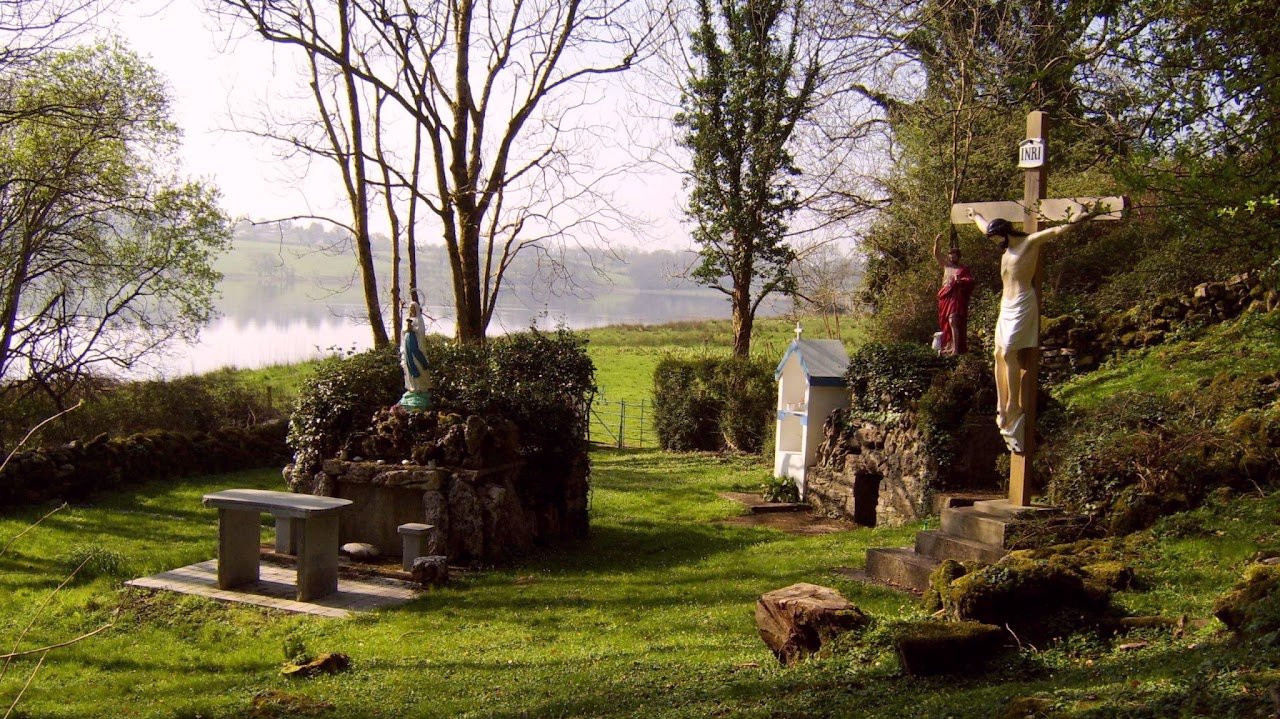
Holy Well of St John the Baptist, Newhall Estate
Chapter V

The Chiefdom of Tulach Commáin

An ancient Gaelic chieftain line in the Burren

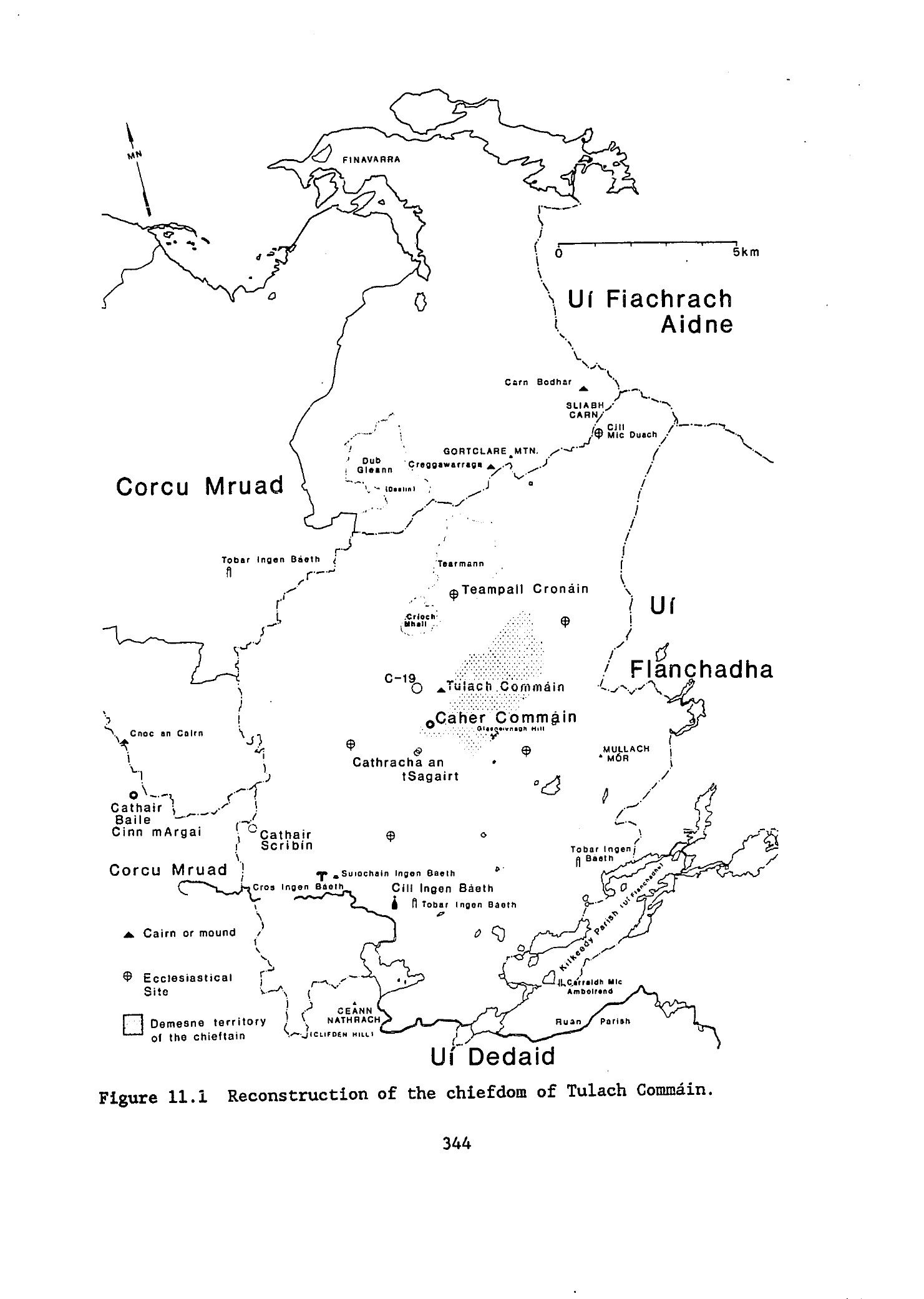
The Chiefdom of Tulach Commáin — "The Mound of Commán" — was the principal political entity of the Ó Comáin family in early medieval Clare. The chiefdom occupied territory in the Burren, the extraordinary limestone plateau of north Clare, and its capital was the great triple ring stone fort of Cahercommane.19

According to the Cambridge University Press analysis of the chiefdom by D. Blair Gibson, Tulach Commáin was an important but not dominant chiefdom within the broader political landscape of the Kingdom of Cashel, controlling or heavily influencing large parts of the Burren in the 8th and 9th centuries.20

The 1585 deed of Queen Elizabeth I references "Tullagh Coman" as a place name — confirming the persistence of the Comáin name in the Burren landscape into the Elizabethan period, centuries after the chiefdom had faded from political life.21 Thomas Johnson Westropp, the Irish antiquarian and president of the Royal Society of Antiquaries of Ireland, documented the site in his early 20th century surveys, noting that the personal name Commán was likely the root of both the fort and the townland names.22

As late as the 19th century, Tulach Commáin — the burial and inauguration site of the chieftains — was regarded as a supernaturally potent spot by local tradition. A local told an archaeologist: "it has more fairies than all the other forts of the hill."23

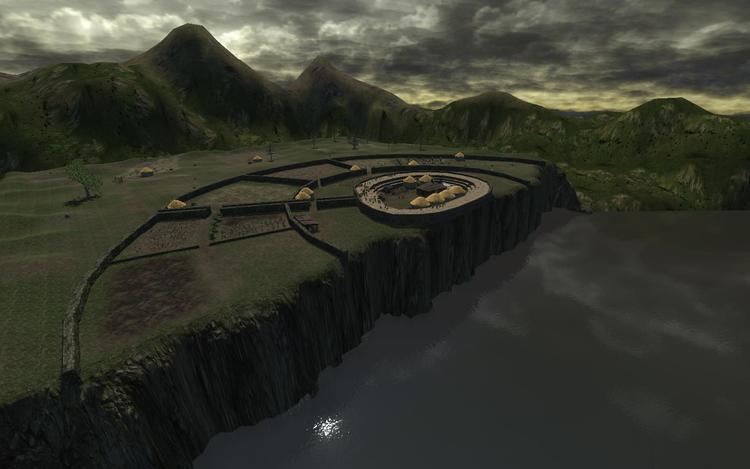
Cahercommane 3D remodel
3D remodel of Cahercommane at the height of the chiefdom
Chapter VI

Cahercommane

The ancestral capital — archaeology and place name

Cahercommane — Cathair Chomáin, "Fort of Commán" — is a triple ring stone fort on the south-east edge of the Burren, in Kilnaboy, near the village of Carran in County Clare. The inner wall alone used an estimated 16,500 tons of stone, the outer wall measuring approximately 350 feet east-west by 245 feet north-south. The fort sits dramatically on the edge of an inland cliff, with three concentric walls reaching to the cliff edge.24

The site was excavated in 1934 by the Third Harvard Archaeological Expedition, led by Hugh O'Neill Hencken, in a six-week excavation that established the fort as the capital of an early medieval chiefdom. Archaeological evidence found of settlement dating back to the 5th and 6th centuries, with the fort itself built in the 9th century. A silver brooch found in one of the souterrains — similar in design to the Tara brooch and now held in the National Museum of Ireland — confirms occupation by the 9th century AD.25

In his 1938 report, Hencken retained the spelling Cahercommaun despite the Ordnance Survey map showing Cahircommane — "in spite of possible linguistic objections" (Hencken 1938, 3). Cotter (2012, p.83) confirms Westropp used both "Cahircommane or Cahercommaun." Both agreed the name derived from the personal name Commán. Cotter establishes that the valley containing Cahercommane, Cashlaun Gar and Glencurraun "suggests strongly that the second element of the fort's name at least includes the personal name Commán," and that the element -aun derives from Irish -án, not -an(n).26

Cotter (2012, p.90) draws a landmark conclusion: Cahercommane most probably gained its name from a Uí Fidgeinti sub-king named Commán — and that this identification "suggests a historical horizon for the construction and use of some of these forts at a particular period." From at least the 7th century, north Clare was contested between Corcu Modruad, the Uí Fidgeinti, In Déis Tuaiscirt and the Connachta. Cotter also identifies the 1585 deed in The Irish Fiants of Elizabeth I — referencing "Dermod O'Flanygan of Cahirekamon" and "Tullagh Coman" twice — as the earliest documentary mention of both names.26

There are no signs of occupation past the 10th century — the chiefdom appears to have dissolved or been absorbed into the expanding Dál Cais confederacy under the O'Brien dynasty. The site was abandoned, but the name survived, embedded in the landscape in both the place name Cahercommane and the nearby townland of Tullycommon (Tulach Commáin).27

The name — two spellings
Cahercommaun
Used by Hencken (1938) and the Harvard expedition. The standard modern archaeological spelling.
Cahircommane
Used on the Ordnance Survey 6-inch map. Noted by Hencken as an alternate form.
Cathair Chomáin
The original Irish: "Fort of Commán" — the personal name of the chief from whom both the fort and the chiefdom took their name.
Chapter VII

The fall of a chieftain line

Dispossession and the documentary gap

By the 13th century, the Commane family — chiefs of the ancient Chiefdom of Tulach Commáin, with their own inauguration site at Cahercommane — were dispossessed of their ancestral lands following the Anglo-Norman invasion, when King Henry III granted the Lordship of Connacht to the De Burc (Burke) family in 1225.28

The last recorded head of the family, Conall O'Comain, is noted at this point in the O'Hart pedigree, at which the family lost their territorial authority and patrimony after centuries of chiefly rule. That the clan possessed a formal inauguration site — Tulach Commáin — confirms this was no ordinary noble family, but a genuine Gaelic chieftain line whose dispossession marked the end of an ancient order in Clare.29

The documentary gap between 1225 and the first post-medieval census record of 1659 — four and a half centuries — reflects the broader destruction of Gaelic Irish institutional memory during the years of Norman and later Tudor conquest. The family survived, but their history survived only in fragments: a place name, a pedigree in the great manuscripts, scattered annalistic references.

The gap may be bridged in future through the Registry of Deeds (from 1708), the Conyngham estate papers, the Civil Survey of 1654, the Hearth Money Rolls of 1664, and the Fiants of the Tudor Sovereigns — all sources that may yet yield documentary evidence of the family in the intervening centuries.

The Anglo-Norman invasion of Ireland
The Anglo-Norman conquest — the force that dispossessed Conall O'Comain and ended centuries of chiefly rule in 1225
Chapter VIII

The name endures

Documentary traces across five centuries

Despite the documentary gap following the 1225 dispossession, the Comyn/Commane name continues to appear in Clare and Munster records across the subsequent centuries. A family of Comyn is recorded in Limerick by c. 1440, with Sir William Comyn, knight, documented as ancestor of the Comyns of Corcomroe and Kilcorney — the Kilcorney family being seated in the Barony of Corcomroe in the Burren, the very heartland of the ancestral chiefdom. A pedigree of this family was registered with the Ulster King of Arms in 1748.30

An Elizabethan deed of 1585 references "Tullagh Coman" as the name of a townland — preserving the ancient Chiefdom of Tulach Commáin in the legal record of the English administration four centuries after the dispossession.31

In 1619, James Comyn received Doonbeg Castle from Daniel O'Brien — evidence that a family bearing the Comyn/Commane name retained sufficient standing in Clare to receive a castle grant from the O'Brien lordship, centuries after the formal loss of their own territory.32

Pender's Census of 1659 records "Comane &c" — 11 persons — in the Barony of Tulla, County Clare: the first confirmed post-medieval population record placing the family in Clare following the centuries-long documentary gap.33

Edward MacLysaght, the first Chief Herald of Ireland and author of Irish Families (1985), confirmed that the name appears as Ó Comáin in Munster — "whence come the majority of present day Cumminses (also called Commane) now found in Counties Tipperary and Cork."34 The name Na Comáin is confirmed by Logainm.ie as a townland in the Iveragh barony of Kerry, in the Gaeltacht area of Dromod parish, confirming the family's geographic distribution across the Munster seaboard.35

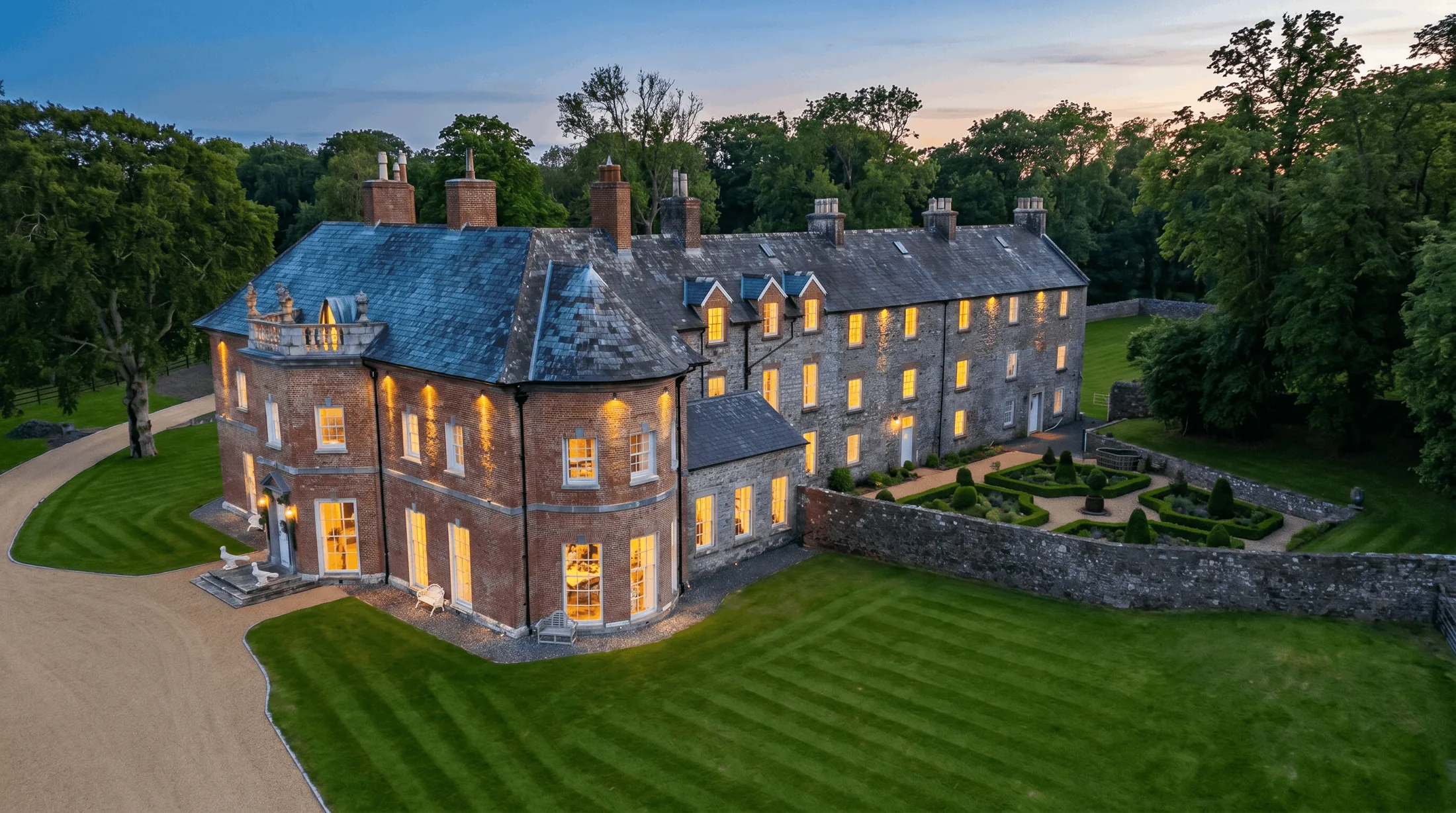
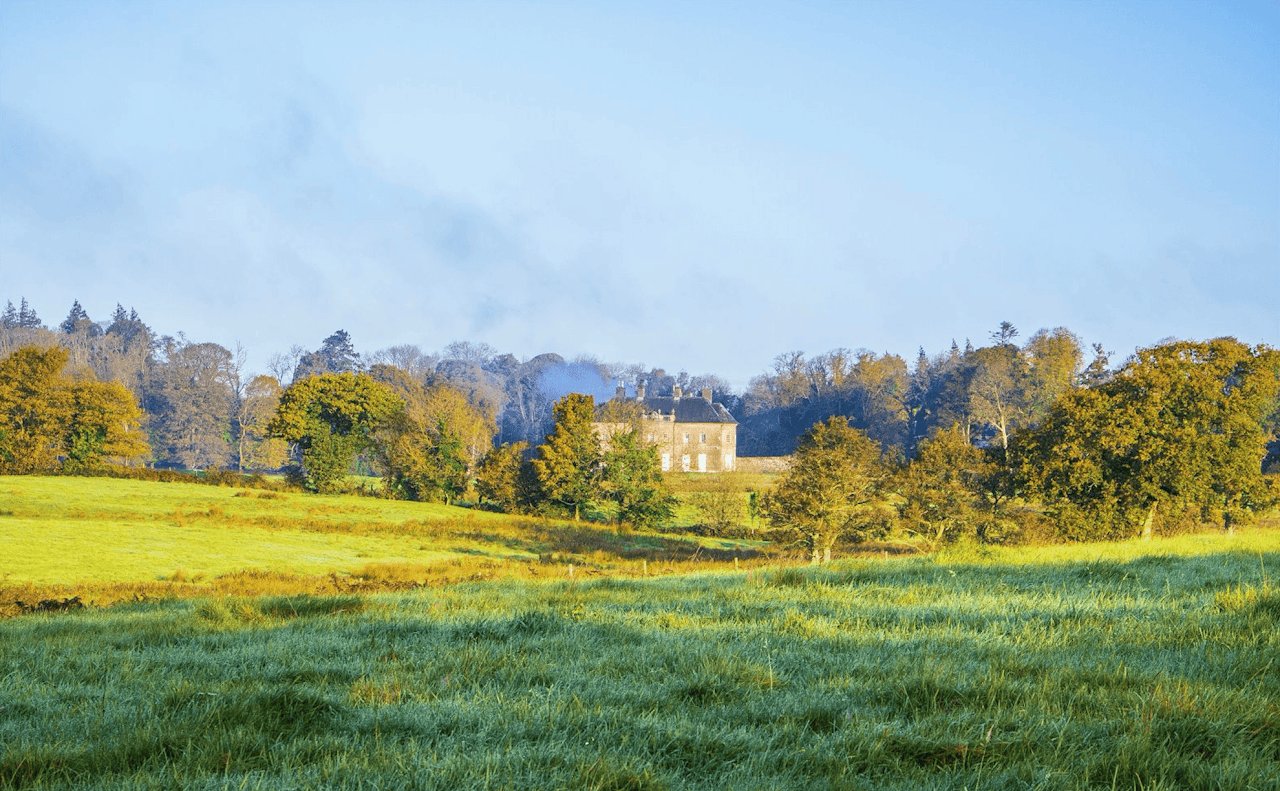
Newhall House at dusk — clan seat
Newhall House — the modern clan seat, within the ancient landscape of the chiefdom
Chapter IX

The modern record

From the Tithe Books to the present

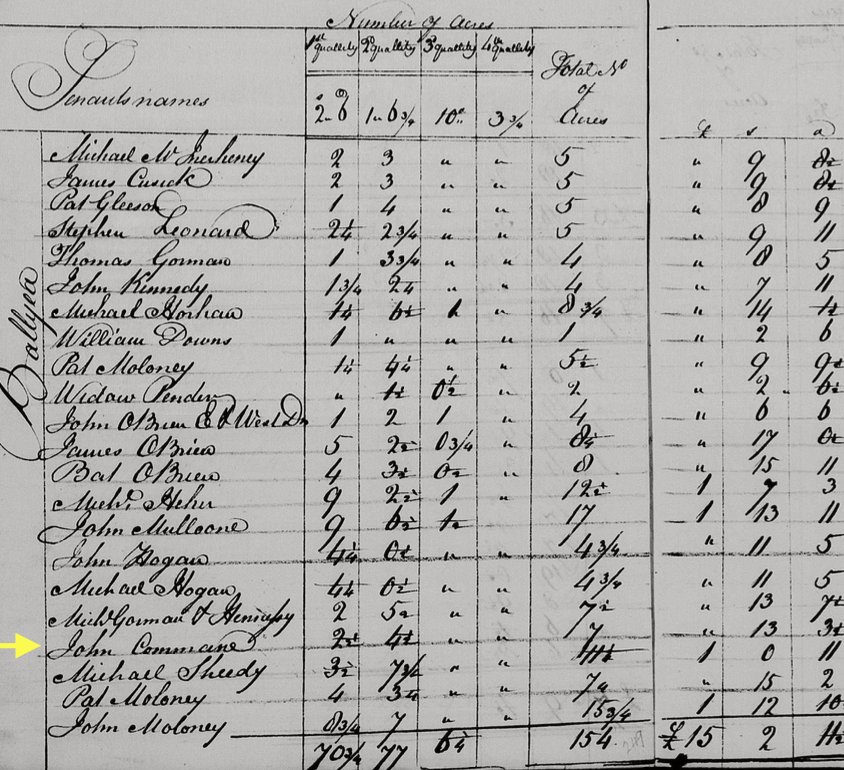
Among the individuals identified in the documented modern Commane line is John Commane, of Newhall, recorded as a tenant in Ballyea townland, Killone parish, County Clare in the Tithe Applotment Book of 1828 — Ballyea and Killone lying in the same immediate territory as Newhall, marking a subtle but resonant historic connection to the clan's present seat. His neighbour in the same townland was Mich'l Hehir — a remarkable echo across more than a millennium of the two ancient Clare families of the Burren sharing territory.36

John Commane is absent from Griffith's Valuation of 1855 for Killone parish, indicating he either died during the Great Famine of 1845–1852 or emigrated in the Famine period — as so many Clare families did. A Commane Road in Baldwinsville, New York (Onondaga County) testifies to Famine-era emigration of the family to upstate New York, where the family left a road name as their legacy in the American landscape.37

The Clare Comyns — erenaghs, poets and French nobility

MacLysaght's Irish Families (1972) records a branch of the Clare Comyn family of particular distinction. Michael Comyn (1688–1760), of Kilcorcoran, County Clare — a man of the same Clare sept — was one of the most celebrated Gaelic poets of the 18th century, composing in the classical Irish tradition at a time when the Gaelic literary order had been largely destroyed by the Penal Laws.41

His son, Michael Comyn (b. 1704), followed the path of the Wild Geese — the Irish Gaelic soldiers, scholars and families who fled into exile on the Continent after the Jacobite defeat of 1691. He emigrated to France, where he was accepted as one of the nobility of France — a formal recognition of his Gaelic aristocratic lineage by the French court, which maintained a register of Irish noble families in exile throughout the 18th century.42

A Clare Comyn — of the same sept as the Ó Comáin of Cahercommane and Newhall — was accepted as a member of the French nobility. His grandson died on the scaffold in Paris in 1793.

His grandson, John Francis Comyn (1742–1793), was guillotined as an aristocrat during the French Revolution — a Clare family that had risen from the stone forts of the Burren to the aristocracy of France, and was destroyed in the Terror that swept that aristocracy away. The arc of this single line — from a 7th-century Gaelic kingship to a 1793 Parisian scaffold — encapsulates the full trajectory of the Gaelic world in three centuries of exile.43

David Comyn (1853–1907), another Clareman of the name, was active in the cultural movements of the late 19th century that led to the formation of the Gaelic League — the organisation that would become the principal vehicle of the Irish language revival and a direct precursor to the independence movement. The Clare Comyn tradition of letters, from the 18th-century poet to the Gaelic League activist, represents a continuous thread of Gaelic cultural commitment across two centuries.44

MacLysaght also records that the family were historically erenaghs — hereditary custodians of church lands — of the church of St. Cuimín Fada in Connacht, with the parish of Kilcuimin on the western shore of the Bay of Killala named after the saint. This ecclesiastical custodianship, which placed the family among the hereditary religious aristocracy of Connacht, is consistent with the family's documented connection to Saint Commán — founder of Roscommon — recorded across multiple primary sources.45

John O'Hart's Irish Pedigrees (1892), compiled from the Book of Lecan and Book of Leinster, recorded the full O'Comain pedigree tracing the royal descent — providing the first modern scholarly compilation of the family's documented genealogy in a published form.38

The Harvard Archaeological Expedition's excavation of Cahercommane in 1934, and D. Blair Gibson's Cambridge University Press monograph From Chiefdom to State in Early Ireland (2012), provided the most detailed modern scholarly analyses of the chiefdom — establishing Cahercommane as a major early medieval political centre and situating the Ó Comáin family within the broader political geography of early medieval Clare.39

Newhall House & Estate in morning light, County Clare
Newhall House & Estate, Newhall, Co. Clare — clan seat of Clan Ó Comáin
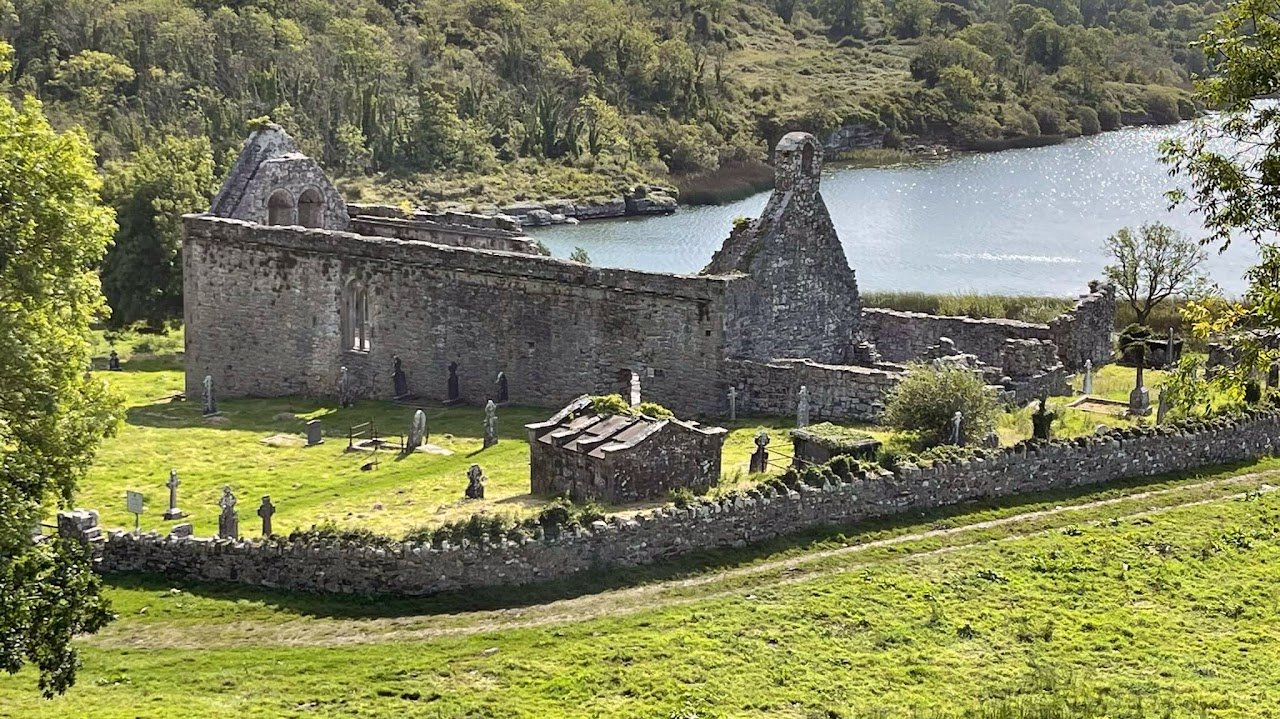
Killone Abbey with lake, Newhall Estate
Killone Abbey — 12th century Augustinian priory, Newhall Estate
Chapter X

DNA — 4,000 years confirmed

The genetic record of the Commane male line

Big-Y DNA testing of the Commane male line confirms the family's ancient Irish roots through haplogroup R-L21 — the defining genetic marker of the Celtic peoples of Ireland, Scotland, Wales and Brittany — placing their male ancestry within the Bronze Age population that settled the western edge of Ireland over 4,000 years ago.1

The complete confirmed haplogroup chain is: R-M269 → R-L23 → R-L51 → R-P310 → R-L151 → R-P312 → R-Z290 → R-L21 → R-S552 → R-DF13 → R-ZZ10_1 → R-Z253 → R-Z2534 → R-ZZ5_1 → R-Z2185 → R-BY44331 → R-Z2186 → R-Z2183 → R-L1066 → R-FTT21 → R-FGC35529 → R-BY14247 (terminal).

R-L21 is the defining haplogroup of the Irish and Celtic peoples — Ireland dominates the distribution with 678 matches.2 R-Z253 is strongly Irish, with Ireland having 110 matches against Scotland's 47. R-Z2534 is shared with the ancestors of the Dál Cais dynasty — the family of Brian Boru and the O'Brien, MacNamara and O'Dea lords of Clare — suggesting a prehistoric common ancestor approximately 3,500 years ago.4

R-L1066 has been identified in ancient remains from Scotland dating to 1500–1300 BC, with a further ancient individual dated between 43 BC and 117 AD.2 The terminal haplogroup R-BY14247 is found in Ireland, with a single confirmed living DNA match — Cornelius Moylan, an Irish surname from Clare and Munster — representing the most promising living genealogical connection.3

Chapter XI

The clan revival

2025 — a new chapter in an ancient story

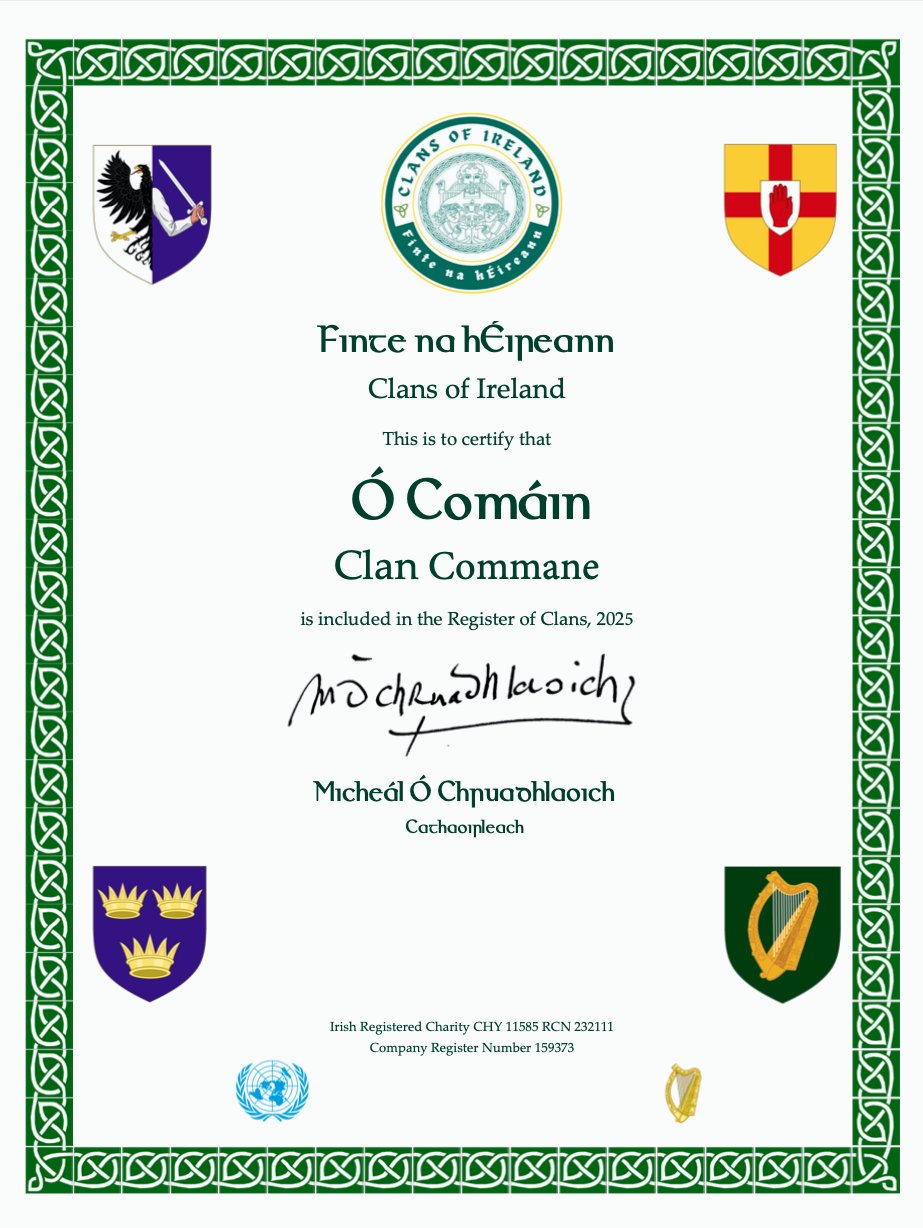
Clan Ó Comáin was officially recognised by Clans of Ireland — Finte na hÉireann — in 2025, under the patronage of Michael D. Higgins, President of Ireland. The committee of Clans of Ireland verified the antiquity of the Irish Gaelic name and the clan's rightful place among the historic families of Ireland.40

The clan revival was inspired by the memory of Ronan James Patrick Commane (1989–2023), the second son of Fergus Commane, Chief of Clan Ó Comáin. Ronan's love for his extended family and for all people inspired the rebirth of the clan in his memory.

Fergus Commane, as Taoiseach successor consecrated by derbhfine under Brehon law, leads the clan from the ancestral seat of Newhall House in County Clare — within the same Clare landscape where the family's name has been recorded continuously since the 7th century. He is also custodian of Killone Abbey and the Holy Well of St John the Baptist on the Newhall Estate.

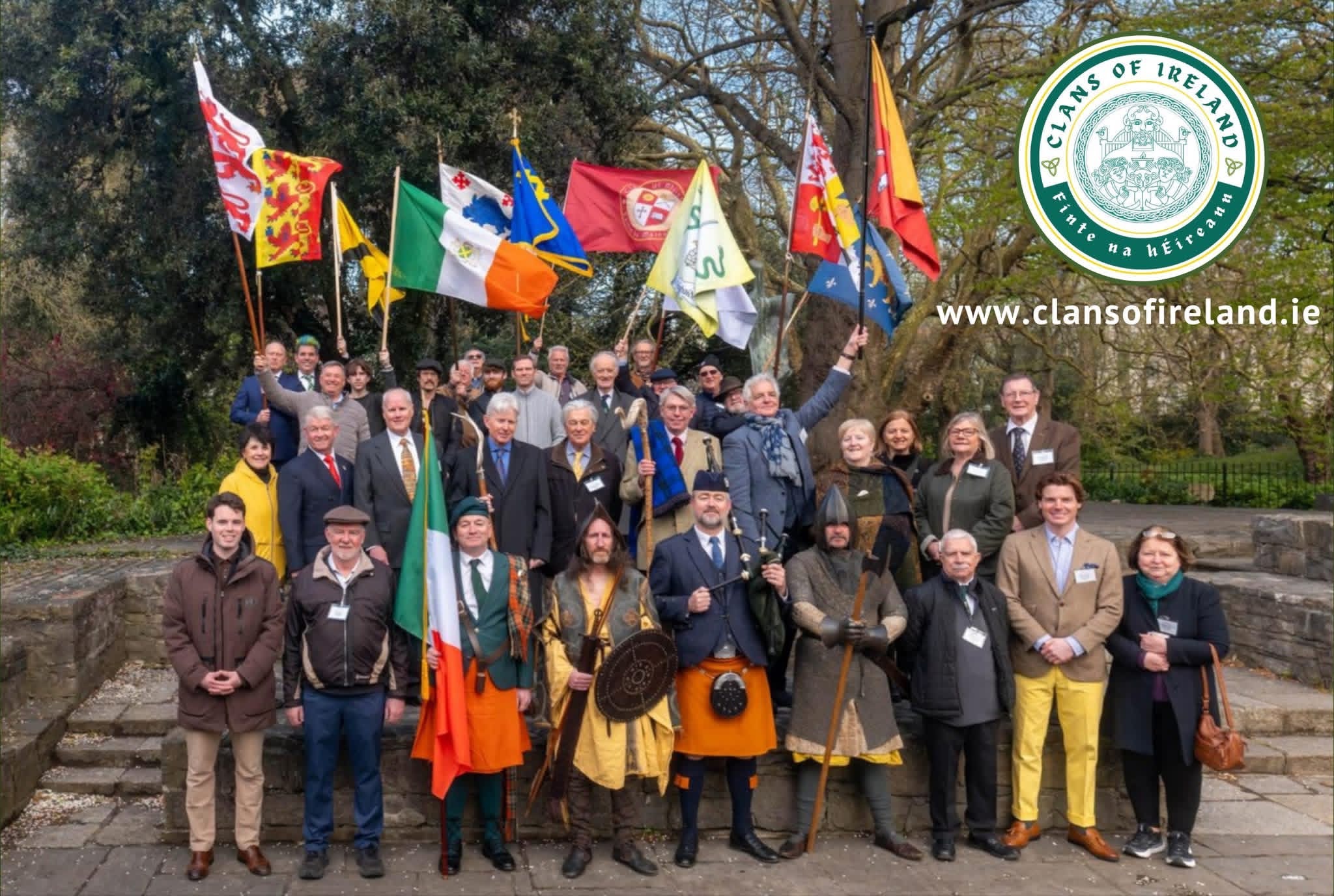
The clan has also been noted in Burke's Peerage and is listed in the Clans of Ireland Register 2026. Antoin Commane serves as Clan Tanist, representing the clan at official gatherings including the 2026 Clans of Ireland assembly in Dublin.

The clan welcomes all who carry the name in any of its variants, all who trace their roots to Ireland, and all who love Gaelic culture and heritage — from County Clare to Chicago, from Kerry to New York, from Munster to Melbourne. The story of Clan Ó Comáin is one of the oldest in Ireland — and it is far from over.

Clans of Ireland Certificate of Recognition — Ó Comáin / Clan Commane, Register of Clans 2025
Certificate of Recognition — Finte na hÉireann / Clans of Ireland, 2025. Signed by Micheál Ó Cnuaóhlaoich, Cathaoirleach.
Clans of Ireland gathering Dublin 2026
Clan Ó Comáin at the Clans of Ireland gathering, Dublin 2026
Sources & footnotes

References

  1. 1Family Tree DNA, Big-Y 700 test results, Kit No. IN143661. Haplogroup R-BY14247 confirmed. R-L21 block tree verified via FTDNA block tree viewer, April 2026.
  2. 2R-L1066 ancient DNA identifications: ancient remains Scotland 1500–1300 BC; further ancient individual Scotland 43 BC–117 AD. Source: FTDNA haplogroup project research data and academic aDNA studies referenced in the R-L21 project. R-L21 Ireland distribution: 678 matches (FTDNA). R-Z253 Ireland 110 vs Scotland 47.
  3. 3R-BY14247 terminal haplogroup: Ireland + 1 unknown. Living DNA match: Cornelius Moylan, identified via FTDNA matching. Moylan is an Irish surname associated with Clare and Munster.
  4. 4R-Z2534 shared haplogroup with Dál Cais/O'Brien/MacNamara/O'Dea of Clare. Estimated common ancestor c. 1,500 BC based on SNP dating methodology. FTDNA block tree analysis.
  5. 5O'Hart, John. Irish Pedigrees, or the Origin and Stem of the Irish Nation. 5th edition. Dublin: James Duffy & Co., 1892. O'Comain pedigree compiled from Book of Lecan and Book of Leinster.
  6. 6Kingdom of Uí Maine: established by Máine Mór mac Eochaidh, c. 357 AD. O'Hart (1892). The kingdom occupied what is now east Galway and south Roscommon.
  7. 7Cairbre Crom, 11th King of Uí Maine, fl. c. 556 AD. O'Hart (1892). Related families through Cairbre Crom: Clancy, Kelly, Madden, Tracy, Hannan, Kenny, Colman, Egan, Larkin.
  8. 8Death of Breanan Dall, 12th King of Uí Maine: Annals of Ulster, 597 AD (also noted at 601 AD in some recensions). Mac Airt, Seán and Mac Niocaill, Gearóid (eds.). The Annals of Ulster. Dublin: DIAS, 1983.
  9. 9Suibne mac Comáin, king of the Déisi Munster, died 658 AD: Annals of Ulster. Also in the Dessi Genealogies, Book of Lecan and Book of Leinster.
  10. 10Congal mac Suibne, king of the Déisi, died 701 AD: Annals of Ulster.
  11. 11Célechair mac Comáin, killed in battle in Clare 705 AD: Annals of Ulster.
  12. 12Dessi Genealogies in the Book of Lecan, Rawlinson B 502, and the Book of Leinster. Referenced in: O'Brien, M.A. (ed.). Corpus Genealogiarum Hiberniae. Dublin: DIAS, 1962.
  13. 13Cotter, Claire. Archaeological analysis of the Burren chiefdoms, referenced in: Gibson, D. Blair. From Chiefdom to State in Early Ireland. Cambridge: Cambridge University Press, 2012, p. 147.
  14. 14Death of Saint Commán 747 AD: Annals of Ulster. Mac Airt & Mac Niocaill (eds.) (1983).
  15. 15Dictionary of National Biography (1887), entry for Commán of Roscommon: "also founded the church of Ceann Mara, now Kinvara." Oxford Dictionary of National Biography confirms death date 747 AD.
  16. 16Death of Colmán mac Comáin on the Aran Islands 751 AD: Annals of Inisfallen. Mac Airt, Seán (ed.). The Annals of Inisfallen. Dublin: DIAS, 1951.
  17. 17Gilla Cómáin mac Gilla Samthainde, fl. c. 1072 AD, poet. Works incorporated in the Lebor Gabála Érenn. Mac Alister, R.A.S. (ed. and trans.). Lebor Gabála Érenn. Irish Texts Society, 1938–1956.
  18. 18Ferchess mac Commán: early Irish mythology, household of King Ailill. Referenced in the early Irish saga tradition.
  19. 19Gibson, D. Blair. From Chiefdom to State in Early Ireland. Cambridge: Cambridge University Press, 2012. Chapter 4: "An Early Medieval Chiefdom of Northern Clare."
  20. 20Gibson (2012), p. 89–147. The chiefdom characterised as "important but not dominant" within the Kingdom of Cashel's political sphere.
  21. 211585 Elizabethan deed referencing "Tullagh Coman": noted by Thomas Johnson Westropp in his surveys. Westropp, T.J. Archaeology of the Burren. Proceedings of the Royal Irish Academy, 1900–1902.
  22. 22Westropp, Thomas Johnson. Early 20th century surveys of the Burren. Westropp served as president of the Royal Society of Antiquaries of Ireland and documented Clare's antiquities extensively.
  23. 23"It has more fairies than all the other forts of the hill" — local tradition recorded by an antiquarian survey, cited in: Ó Comáin, Wikipedia article on Ó Comáin, citing original survey documentation.
  24. 24Cahercommane dimensions: outer wall 350ft east-west × 245ft north-south. Inner wall: 5ft thick, 4ft high, rises 12–14 feet above the cliff. 16,500 tons of stone in the inner wall. Hencken, H.O'N. Cahercommane: A Stone Fort in County Clare. Royal Society of Antiquaries of Ireland, 1938.
  25. 25Third Harvard Archaeological Expedition, 1934, led by Hugh O'Neill Hencken. Silver brooch, National Museum of Ireland. Hencken (1938).
  26. 26Hencken, H.O'N. Cahercommaun: A Stone Fort in County Clare. Royal Society of Antiquaries of Ireland, 1938, p.3: retained "Cahercommaun" "in spite of possible linguistic objections." Cotter, Claire. Western Stone Forts Project: Excavations at Dún Aonghasa and Dún Eoghanachta. Discovery Programme monograph. Wordwell Ltd, 2012, pp. 83–87–90 (ISBN 978-1-905569-69-4). Cotter confirms Westropp used both "Cahircommane" and "Cahercommaun"; establishes the element -aun derives from Irish -án; concludes the fort most probably took its name from a Uí Fidgeinti sub-king named Commán; and identifies the 1585 deed in Irish Fiants of Elizabeth I as the earliest documentary reference to both Cahercommane and Tullycommon.
  27. 27No occupation past the 10th century: archaeological evidence from the 1934 Harvard excavation. Gibson (2012), p. 102.
  28. 28Henry III grant of Lordship of Connacht to De Burc (Burke) family, 1225. Calendar of Documents relating to Ireland, 1171–1251.
  29. 29Conall O'Comain, last recorded head of family: O'Hart (1892), citing Book of Lecan and Book of Leinster.
  30. 30Comyns of Kilcorney, Barony of Corcomroe, Burren: pedigree registered with Ulster King of Arms 1748. Burke's Landed Gentry of Great Britain and Ireland, 1802, pp. 277–278. Sir William Comyn of Limerick, c. 1440, as ancestor.
  31. 311585 Elizabethan deed: "Tullagh Coman." Westropp surveys. See footnote 21.
  32. 32James Comyn receives Doonbeg Castle from Daniel O'Brien, 1619. Clare county records.
  33. 33Pender's Census 1659: "Comane &c" — 11 persons, Barony of Tulla, County Clare. Pender, Séamus (ed.). A Census of Ireland circa 1659. Dublin: Stationery Office, 1939.
  34. 34MacLysaght, Edward. Irish Families, their Names, Arms and Origins. 4th edition. Dublin: Irish Academic Press, 1985, pp. 66–67.
  35. 35Na Comáin, Iveragh barony, Kerry: Logainm.ie confirmed Irish form Na Comáin, genitive na gComán, Dromod parish, Gaeltacht area.
  36. 36John Commane, of Newhall, Ballyea townland, Killone parish: Tithe Applotment Book 1828. National Archives of Ireland. Ballyea and Killone are contiguous with the Newhall demesne.
  37. 37Commane Road, Baldwinsville, New York (Onondaga County). John Commane absent from Griffith's Valuation 1855 for Killone parish.
  38. 38O'Hart, John. Irish Pedigrees (1892). See footnote 5.
  39. 39Gibson, D. Blair. From Chiefdom to State in Early Ireland. Cambridge University Press, 2012. ISBN 978-0-521-12432-8.
  40. 40Clan Ó Comáin recognised by Clans of Ireland 2025. Register of Clans 2026, Clans of Ireland — Finte na hÉireann. www.clansofireland.ie.
  41. 41Michael Comyn (1688–1760), of Kilcorcoran, Co. Clare, Gaelic poet. MacLysaght, Edward. Irish Families, their Names, Arms and Origins. Dublin, 1972, p. 103.
  42. 42Michael Comyn (b. 1704), emigrated to France; accepted as nobility of France. MacLysaght (1972), p. 103. See also the Irish Brigades register of noble families in exile.
  43. 43John Francis Comyn (1742–1793), guillotined during the French Revolution as an aristocrat. MacLysaght (1972), p. 103.
  44. 44David Comyn (1853–1907), Clareman, active in the Gaelic League formation. MacLysaght (1972), p. 103.
  45. 45The family as erenaghs of St. Cuimín Fada's church, Connacht; parish of Kilcuimin, Bay of Killala. MacLysaght, Edward. Irish Families (1972), p. 103.