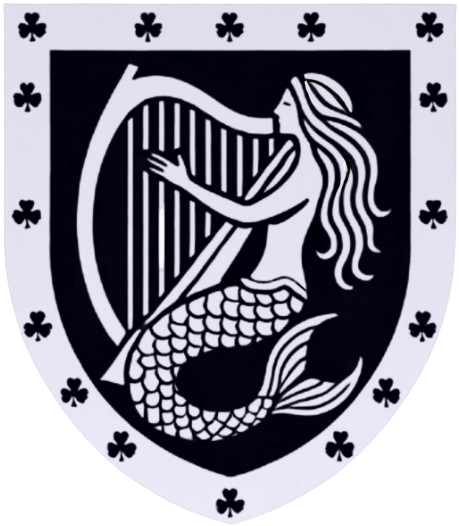
The surname Ó Comáin originates from the ancient Gaelic tradition, meaning "descendant of Comán." The name Comán or Commán means noble or communion. Over centuries of anglicisation, migration and clerical misrecording, the name evolved into dozens of different forms — many of which are still found across Ireland, Britain, America, Australia and the wider Irish diaspora.
Primary scholarship · 1972
MacLysaght's Irish Families on the origin of the name
In Irish Families: Their Names, Arms and Origins (Irish Academic Press, revised edition 1972, p.103), Edward MacLysaght — the first Chief Herald of Ireland and the foundational authority on Irish family names — set out the geographic and ecclesiastical origins of Ó Comáin in unusually full terms:
"Notwithstanding its very English appearance Cummins is a Gaelic Irish surname quite distinct from the English Cummings and Cumming, though sometimes the original Ó Coimín takes those forms as its anglicised synonyms… Ó Coimín is first found in Connacht: the family were erenaghs of the church of St Cuimín Fada, and the parish of Kilcummin on the western side of the Bay of Killala is named after them… It appears as Ó Comáin in Munster, whence come the majority of present day Cumminses (also called Commane) now found in Counties Tipperary and Cork. There they are sometimes called Hurley, through a mistranslation, camán being the Gaelic word for a hurley-stick."
Three points are worth drawing out. First, MacLysaght establishes a Gaelic ecclesiastical foundation for the family — the Ó Coimín line as erenaghs (hereditary stewards of church lands) of the church of St Cuimín Fada, with the parish of Kilcummin on Killala Bay carrying their name. Second, he identifies Munster Ó Comáin as the source of the majority of present-day Cumminses — a population statement that anchors the modern Cummins / Commane / Commons surnames to a Gaelic origin in the south-west, where this clan is centred. Third — writing thirteen years before The Surnames of Ireland — he had already characterised the Hurley anglicisation as a mistranslation. His position was consistent across two decades of scholarship.
On the cam reading
The Woulfe cam etymology — manuscript and authority both against it
Online sources frequently cite Patrick Woulfe's 1923 etymology — that the name derives from Irish cam (crooked, bent) — and many commercial heraldry sites continue to repeat it. This reading was already explicitly rejected by Edward MacLysaght, the first Chief Herald of Ireland, who treated Woulfe's etymology in The Surnames of Ireland (Irish Academic Press, 1985, pp.52–53) in a single sentence:
"Woulfe says it is from cam, crooked, which is equally unacceptable."
MacLysaght's own reading places the name as a Gaelic ancestral surname — Ó Comáin in Munster and Ó Cuimín in Connacht — derived not from a physical-trait byname but from a named ancestor: Coman / Cuimín. This is the standard scholarly position, set out in his fuller treatment in Irish Families (1972) above.
The manuscript evidence reinforces this from another direction. Pender's Déisi genealogies placed the parallel medieval genealogies side by side (Book of Lecan, Book of Leinster, Book of Ballymote) and preserved the clan-anchor's name as it appears across the three manuscripts, spelt Cóemán, Comáin, Coman and Comaen — the same person and the same genealogy in each, written in different hands across the medieval centuries.
Two independent etymological trails in the Dictionary of the Irish Language both rule out the cam derivation. The first — through the manuscript spelling Cóemán — leads to the Old Irish root cóem, meaning "dear, precious, beloved" with a secondary sense of "noble" (Dictionary of the Irish Language, Royal Irish Academy). The second — through searches in eDIL for the related spellings comain, comman, and coman — leads to the com- prefix family: commaín ("wealth, favour, return-gift") and comann ("fellowship, communion"). Both families are etymologically distinct from cam ("crooked, bent"), whose own diminutive is camán (the hurley-stick). Harrison's Surnames of the United Kingdom (1912) made exactly this attribution: "We find the personal names Coman, Comman, and Comaoine in the old Irish Annals [Irish comann, comaoin, comaoine, benefit, also communion]."
Beyond etymology, the distribution of the personal name reinforces the same reading. Comán appears in royal pedigrees across all four provinces of Ireland — the Déisi Muman of the Cobthach line, the Uí Fidgente / Uí Cormaic of Munster, the Dál Gealla among the Offaly tribes, the Uí Maine of Connacht through Coman mac Bréanainn Dall, the Leinster Lagin under the Cathaír Már descent through Dáire Barrach, the parallel Cathaír Már line through Eochaidh Timín and Conall mac Nath Í, the Dál Meisin Corb of Chluain Tarbh, the Ulaid placement through Ír, the northern Uí Néill descent through Niall of the Nine Hostages and Flann Léana, and the Oriel placement through Colla Fo Chrí in the Airgialla. Alongside this, the saint Commán of Roscommon and his successor line carried the same name into the ecclesiastical record.
Whether the surname Ó Comáin descends from a single chiefly line or crystallised in parallel across multiple chiefly families is an open scholarly question — but on either reading, the name appearing across ten royal lineages, and as the name borne by saints, is positively inconsistent with a "crooked" or "bent" trait nickname. The Woulfe cam reading is not just rejected by MacLysaght; the manuscripts themselves cannot accommodate it.
What this tells us
A surname rooted in royal, saintly and noble lineages
Surnames in medieval Ireland did not form uniformly across the population. The common people received surnames largely based on physical traits, occupation or locality — their deeper lineages had not been recorded and were not available to draw on. Only the chiefly and royal families had the institutional means — preserved genealogies — to anchor a hereditary surname on a named royal ancestor of direct descent. By common estimate, only around 10% of Irish surnames today preserve this kind of dynastic anchoring back to a royal pedigree — and Ó Comáin, with the personal name documented across ten royal lineages and the modern surname rare and geographically concentrated, sits firmly within that minority. Had the surname formed across the wider kindreds, it would be a far commoner Irish surname today; instead it crystallised specifically in the chiefly families honouring a princely ancestor of direct descent. Modern bearers of Ó Comáin and its variants almost certainly descend from a chiefly line within one of those royal kindreds.
Etymology and the rejection of cam
A special case
Hurley — a mistranslation rejected by MacLysaght
The practice of recording Ó Comáin families as "Hurley" in parish and civil records predates any scholarly explanation — it appears in early 19th century records, with families emigrating to Liverpool and beyond already carrying the "Hurley" surname as a result of how priests had recorded the name. Patrick Woulfe (1923) later attempted to explain this by claiming the name derived from cam (crooked), implying a link to camán (a hurling stick) — but this was a rationalisation after the fact, and for some families the name Hurley had already stuck across generations.
Edward MacLysaght, the first Chief Herald of Ireland, explicitly rejected this in The Surnames of Ireland (Irish Academic Press, 1985, pp.52–53):
"Ó Comáin has become Hurley in some parts of Cos. Clare and Cork, due to the mistaken belief that it derives from camán, a hurley. Woulfe says it is from cam, crooked, which is equally unacceptable."
The practical result was documented by Robert E. Matheson, Ireland's Registrar-General, in his 1909 book on Irish surnames — cited by Frank McNally in The Irish Times: "in the middle of a marriage certificate, there would appear such a name as Mary Hurley, while the signature would appear as Mary Commane, the latter being the Irish for hurley stick." Matheson termed this a case of "pseudo-translation" — where a name was replaced not by its real meaning but by a mistaken one.
Surviving evidence on the land
The pseudo-translation pattern is recorded in the landscape itself. At Ballycommane in West Cork — Gaelic Baile Uí Chomáin, "Townland of the descendants of Comán (clan of Ó Comáin)" — the most common surname recorded in the 1901 census was Hurley. The placename kept the Gaelic original; the parish register gave the residents the mistranslated form. See the landscape section below ↓
Read: Frank McNally, 'Synonyms of the Fathers' — The Irish Times ↗
MacLysaght confirms
Munster origin — and Comyn as the Clare anglicisation
MacLysaght's full entry in The Surnames of Ireland (Irish Academic Press, 1985, pp.52–53) for Commane / Commons:
"(O) Commane, Commons — Ó Comáin (in Munster) and Ó Cuimín (in Connacht). Usually called Commons in Co. Wexford and Cummins in Co. Cork. Ó Comáin has become Hurley in some parts of Cos. Clare and Cork, due to the mistaken belief that it derives from camán, a hurley. Woulfe says it is from cam, crooked, which is equally unacceptable."
MacLysaght establishes the geographic origin (Munster) and the principal regional anglicisations: Commons in Wexford, Cummins in Cork, with the Hurley pseudo-translation prevailing in parts of Clare and Cork. The very next entry in his alphabetical listing — placed immediately after Commane/Commons and explicitly cross-referenced back to it ("see previous entry") — is Comyn, where he gives the Clare-specific point that gives this Gaelic line its anglicised form in the documentary record.
MacLysaght's Comyn entry, the next entry in the same volume:
"Comyn — The name of a Norman-Irish family which is also used in Co. Clare as the anglicized form of Ó Cuimín."
This is a crucial scholarly correction. Comyn families have an illustrious history in Clare, and many such pedigrees have historically been treated as Norman-descended on the basis of name alone. MacLysaght's reading — followed by Y-DNA evidence in the modern Ó Comáin line confirming a deep Irish patrilineal cluster — establishes that Comyn in Clare also represents a Gaelic family. The name carries a continuity that runs back to Ó Comáin in Munster and Ó Cuimín in Connacht, not solely to the Norman Comyn line of de Comines.
Ó Cuimín is best read as a regional Gaelic variant of the underlying Munster form Ó Comáin rather than a separate name — the Connacht variant retained in the western and northern dialects, while the Munster form prevailed in the south. Before the standardisation of modern Irish orthography in the mid-20th century — most fully expressed in the Caighdeán Oifigiúil of 1958 — Irish surnames appeared in many spelling variations across both Gaelic and anglicised forms. The same underlying name was recorded as Ó Comáin, Ó Coimín, Ó Cuimín, Ó Comhán and other variants in Gaelic sources, and as Coman, Comaine, Cummane, Comyn, Cummins, Commons and dozens more in English-language records. Ó Comáin is the modern standardised form that has prevailed since.
A note on distinct Clare Comyn families
This regional-variants reading does not collapse all Clare families bearing the Comyn name into a single descent. MacLysaght's own entry recognises a genuine Norman-Irish Comyn family alongside the Gaelic anglicisation, and there are other documented Clare Comyn families — most notably the west Clare line of the 18th-century Gaelic poet Mícheál Coimín (1676–1760) of Miltown Malbay, recorded in Irish as Coimín. Whether such families share a deep common ancestry with our line, descend independently from local Gaelic Coimín / Cuimín / Comáin lines that converged on similar anglicised forms, or in some cases represent the genuinely Norman-descended Comyns MacLysaght identifies separately, is a question that documentary evidence alone cannot fully settle; in the absence of broader Y-DNA testing across Clare Comyn families, we make no claim either way. The Pedigree page sets out the documented descent of this clan's own line; broader claims about the relationship between distinct Clare Comyn families are not made.