Ó Comáin
A genuine Gaelic coat of arms
Authentic Irish arms — not a "family crest" sold online
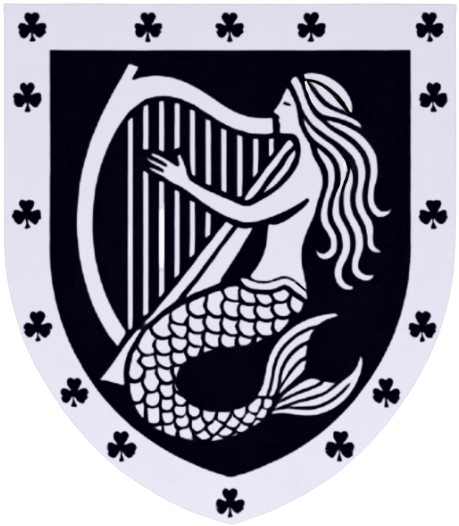
The coat of arms of Clan Ó Comáin is a genuine heraldic design drawn from the Gaelic royal tradition and recognised through the office of the Chief. It carries the mermaid of Newhall Lake, the Irish harp, and the shamrocks of the clan's patron saint, Saint Commán — the three leaves of the shamrock representing the Holy Trinity in the Gaelic Christian tradition. None of this symbolism appears on the generic "family crest" products sold online under this surname.
Under the ancient Gaelic custom of clan arms, only registered members of Clan Ó Comáin are approved by the Chief to display the arms on personal items, stationery, jewellery and ceremonial objects. The arms belong to the clan; their use is a right extended by the Chief to those whose names are entered on the Register at Newhall House.
The Hurley name — three origins, one specific story
The Hurley surname in Ireland has at least three distinct Gaelic origins, a fact that has caused genealogical confusion for almost two centuries. Most Hurley families descend from the native Clare and Cork surnames Ó hUirthile or Ó Muirthile — genuinely ancient Gaelic lines of their own, unrelated to the Ó Comáin family. But a significant minority of Hurley families, particularly in specific parishes of north Clare and west Cork, carry a surname that was originally Ó Comáin — recorded as Hurley by priests and civil clerks who mistakenly believed the Irish name derived from camán, the word for a hurling stick.
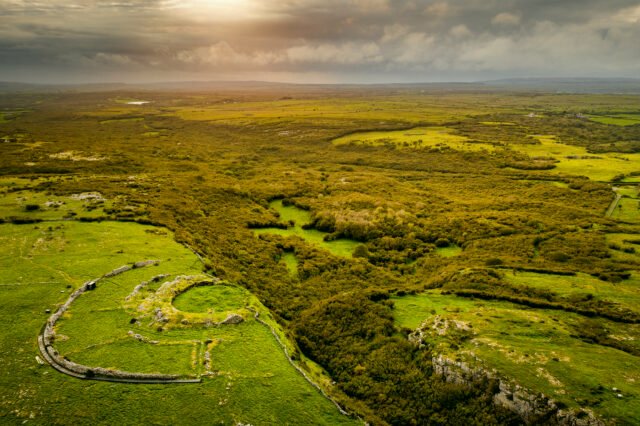
This phenomenon — known in Irish genealogy as pseudo-translation — was documented with care in the 20th century by the Chief Herald of Ireland. For the Hurley families affected, it has meant four or five generations of separation from their true documented lineage: a Gaelic royal line with a surviving clan, a chiefdom in the Burren, an ancestral stone fort at Cahercommane, and an official seat at Newhall House, County Clare.
If your Hurley family comes from Clare or Cork — particularly from around Killone, Kilmihil, or the Burren — there is a real possibility your name was originally Ó Comáin. The paper record was changed. The blood line was not.
King Suibne mac Comáin — the Déisi Muman inheritance
Beyond the Uí Maine royal line in Connacht, the name Comán enters the historical record through another commanding figure: King Suibne mac Comáin of the Déisi Muman (the Déisi of Munster), who died in 658 AD. His entry in the Annals of Ulster places the lineage of Ó Comáin among the ruling kindreds of a distinct early medieval Gaelic kingdom within Munster. His son, Congal mac Suibne, who also held the kingship of the Déisi, died in 701 AD.
The Déisi Muman were not the provincial monarchs of Munster — that title was held by overlord dynasties such as the Eóganachta and, later, the Dál gCais. The Déisi Muman were a distinct kingdom within Munster, with their own territory, their own kings, and a political weight substantial enough to appear repeatedly in the primary sources. Whether the Suibne mac Comáin of the Déisi Muman and the Coman of the Uí Maine royal line in Connacht represent one connected family or two independent lineages sharing the same personal name remains an open scholarly question — both traditions are presented on the clan pedigree honestly.
The origin of the Déisi Muman as a people is itself preserved in medieval Irish literature. The Old Irish narrative The Expulsion of the Déisi (Indarba na nDéisi) records that the kindred was forced out of the Tara region of Leinster — following a dispute during the reign of the High King Cormac mac Airt — and eventually settled in Munster, where they formed an alliance with the Eóganachta to secure their territory. This is the political background from which Suibne's kingship was later exercised.
Further evidence for the Comáin family's extent is preserved in the Annals of Inisfallen, which record the death of Colmán mac Comáin on the Aran Islands in 751 AD — described in the martyrology Félire Óengusso as a bishop of Munster and one of the four sages of Ireland. His probable brother, Célechair mac Commáin, was killed at the battle of Corcu Modruad in 705 AD. D. Blair Gibson, in From Chiefdom to State in Early Ireland (Cambridge University Press, 2012), proposed that the Aran Islands may have fallen within the territory of the Chiefdom of Tulach Commáin itself. Claire Cotter, in the Discovery Programme's Western Stone Forts Project monograph (2012), separately suggests that the brothers' father may have held the chiefship — the sub-king Commán after whom Cahercommane is named. Whether the chiefdom belonged within the Déisi Muman political sphere — as the documented kingship of Suibne mac Comáin over the Déisi Muman would suggest — or within a distinct Uí Fidgeinti sub-lineage as Cotter proposes, remains part of the open scholarly discussion presented on the clan pedigree. Suibne mac Comáin is further referenced in the Déisi Genealogies, in Rawlinson B 502, and in the great medieval manuscript compilations of Irish genealogy — the Book of Lecan and the Book of Leinster — establishing the figure firmly within the primary sources of Gaelic historical record.
The territorial imprint of the name Comán survives in the Irish landscape today. The great stone fort of Cahercommane on the Burren is the best-known monument, but Commane place-names across Kerry and Cork — from townlands to church sites and smaller holdings — mark the wider Munster reach of a family whose name passed, across the 17th, 18th and 19th centuries, into every anglicised spelling now recognised as a variant of the original.
How a priest's misreading became a family name
The mechanics of the Hurley / Ó Comáin pseudo-translation are precisely documented. Edward MacLysaght, the first Chief Herald of Ireland, addressed the phenomenon directly in The Surnames of Ireland (Irish Academic Press, 1985, pp. 52–53):
"Ó Comáin has become Hurley in some parts of Cos. Clare and Cork, due to the mistaken belief that it derives from camán, a hurley. Woulfe says it is from cam, crooked, which is equally unacceptable."
The error arose from a phonetic resemblance. The Irish word camán, with a long 'á', means a hurling stick — the wooden implement used in the ancient Gaelic game of hurling. The Gaelic surname Ó Comáin, pronounced similarly, descends from the entirely unrelated personal name Coman — a 7th-century ancestor of the clan. In the 18th and 19th centuries, as parish clerks, priests, and civil registrars in rural Ireland — often working without literacy in written Gaelic, using English-language forms — recorded local surnames, some Ó Comáin families were "translated" into Hurley on the mistaken assumption that the Irish name referred to a hurley stick.
The 19th-century lexicographer Patrick Woulfe, in Sloinnte Gaedheal is Gall (1923), had tried to justify the translation by suggesting the surname derived from cam ("crooked") — implying a link to camán as a crooked stick. MacLysaght rejected this interpretation explicitly as "equally unacceptable". The real meaning is simpler: descendant of Coman. But the damage had been done long before MacLysaght could write. By 1985, many Hurley families in specific Clare and Cork parishes had been recording themselves as Hurley for four or five generations, unaware that their great-great-grandparents had signed their own marriages under the name Commane.
Two names on one document — the evidence of pseudo-translation
Perhaps the most striking documentary evidence of the Hurley pseudo-translation is a phenomenon recorded by Robert E. Matheson, Ireland's Registrar-General, in his 1909 report on Irish surnames — later cited by Frank McNally in The Irish Times:
"in the middle of a marriage certificate, there would appear such a name as Mary Hurley, while the signature would appear as Mary Commane, the latter being the Irish for hurley stick."
In other words: the priest wrote "Hurley" in English in the body of the marriage certificate, while the woman herself signed her own name — "Commane" — in her own hand below. Both names appear on the same legal document. The priest's translated form sits above the family's preserved form. Matheson termed this a case of pseudo-translation: the replacement of a name not by its real meaning but by a mistaken one.
For the genealogical researcher, this is encouraging: wherever a parish register, marriage certificate, or sworn affidavit preserves both the clerical translation and the family's own handwritten signature, the evidence of the Ó Comáin origin survives. The full context of this phenomenon is explored by Frank McNally in his piece "Synonyms of the Fathers" in The Irish Times — essential reading for any Hurley researcher investigating this angle.
Where the Hurley / Ó Comáin confusion happened — Clare and Cork parishes
MacLysaght identifies the pseudo-translation specifically with "some parts of Cos. Clare and Cork" — a geography that corresponds closely to the historic heartland of the Ó Comáin family. The Clare parishes most strongly associated with the phenomenon cluster in and around the clan's ancestral chiefdom territory in the Burren:
Killone and Ballyea — the Tithe Applotment records of 1828 list a John Commane as a tenant in Ballyea townland, Killone parish. By the 1855 edition of Griffith's Valuation for the same parish, many local family names had begun to appear in the Hurley form — a pattern consistent with the gradual pseudo-translation over a single generation.
Kilmihil and the western Burren parishes — records in 19th-century parish registers show a concentration of Hurley families appearing precisely where Ó Comáin bearers had been recorded in earlier surveys.
Gleninagh, Kilfenora, Carran — the deep Burren parishes, sitting within the territory of the ancient Chiefdom of Tulach Commáin whose capital was the great stone fort of Cahercommane.
In County Cork, the pseudo-translation is associated particularly with the western parishes, in the region between Cork Harbour and the Kerry border. MacLysaght notes that the Ó Comáin name is the root "whence come the majority of present day Cumminses (also called Commane) now found in Counties Tipperary and Cork" — and the Hurley misrecording occurred within the same regional cluster.
For a Hurley researcher wanting to test whether their family's tradition fits this pattern, the parish of origin is the single most useful clue. A Hurley line traced to north Clare or west Cork is substantially more likely — though never certain without DNA — to be originally Ó Comáin than a Hurley line traced to any other part of Ireland.
Signs your Hurley family may be Ó Comáin
No single clue identifies a pseudo-translated Hurley line with complete certainty. But the following signs, taken together, make the Ó Comáin origin significantly more likely:
Parish of origin in north Clare or west Cork. A Hurley family with documented roots in the Burren parishes, or in the west Cork region between Cork Harbour and the Kerry border, is more likely to carry the pseudo-translated Ó Comáin origin than a Hurley family from anywhere else in Ireland.
Spelling drift across generations. A family that appears as Commane, Cummane, Commons, Cummins, Commins, Comyn, or Ó Comáin in one generation of parish records — and as Hurley in the next, in the same parish — has almost certainly experienced the pseudo-translation. Tithe Applotment Books of the 1820s–1840s and early Catholic parish registers sometimes preserve the original Ó Comáin form alongside the later Hurley recording.
Two-name documents. As Matheson recorded, marriage certificates, wills, or leases sometimes carry the priest's or clerk's translation in one hand and a family member's original signature in another. Where such evidence survives, it is effectively conclusive.
Family oral tradition. A Hurley family preserving an oral tradition that the name was "really something Gaelic" or "originally something else" — even if the specific form has been forgotten — is often preserving the memory of a pseudo-translation a century or more distant.
Y-DNA confirmation. The strongest test of all. A male-line Hurley who tests within the Ó Comáin terminal haplogroup R-BY14247 on Big-Y-700 is confirmed as descending from the same Gaelic male line as the documented Ó Comáin pedigree — whatever the 19th-century parish records happen to say.
What DNA can tell a Hurley researcher
Y-DNA testing is the single most powerful tool available to a Hurley researcher hoping to clarify their origin. Where the paper trail is muddied by centuries of pseudo-translation, DNA is not: a male-line Hurley either does or does not share a common Gaelic male-line ancestor with the documented Ó Comáin pedigree.
The Ó Comáin male line carries terminal Y-haplogroup R-BY14247, within the broader R-L21 Celtic group — the defining marker of the Celtic peoples of Ireland, Scotland, Wales and Brittany. The line sits within R-Z2534 — shared with the Dál Cais dynasty of Clare, the family of Brian Boru, and the O'Brien, MacNamara and O'Dea lords of medieval Clare. A male-line Hurley whose test places them within R-BY14247 is, genetically, descended from an Ó Comáin — whatever the 19th-century parish records say.
Big-Y-700 through Family Tree DNA's Big Y project is the gold-standard test. An autosomal test (Ancestry, 23andMe, MyHeritage) will confirm broad Irish ancestry but will not reach surname-specific depth: only Y-DNA follows the direct male line across the centuries of anglicisation, misrecording, and emigration.
A Hurley descendant who tests within R-BY14247 has their answer: they descend from the Ó Comáin lineage, and the 19th-century pseudo-translation is the probable explanation for the Hurley surname they carry today. A Hurley descendant who tests within a different R-L21 branch — or an entirely different haplogroup — has almost certainly descended from one of the other Gaelic origins of the Hurley name, Ó hUirthile or Ó Muirthile among them. Both outcomes are genealogically interesting. Both restore clarity where paper records cannot.
Hurleys in the Irish diaspora
For the Hurley diaspora — in the United States, Canada, Australia, New Zealand, and Britain — the pseudo-translation question is typically one generation further removed from the source. Families emigrating from Clare or Cork in the 19th century carried the Hurley name into the new country and preserved it, often never realising that a great-grandparent one or two generations earlier might have been named Commane or Ó Comáin.
American Hurley families are documented in the emigration and naturalisation records of the 1840s onwards, settling first in the industrial cities of the Northeast — Boston, New York, Philadelphia — and later in the Midwest as Irish settlement extended westward. Canadian Hurleys appear in the 19th-century immigration ledgers at Grosse Île and other ports of entry. Australian Hurleys arrive with the assisted-emigrant schemes of the 1840s and 1850s. British Hurleys concentrate in Liverpool, Manchester, Glasgow and London, often arriving via the pre-Famine and Famine-era migration routes.
For any Hurley diaspora family whose Irish origin parish is in Clare or Cork, the pseudo-translation question is a live one. For Hurleys whose origin parish is elsewhere in Ireland — particularly Kerry, Limerick, Tipperary, or the midland counties — the family is more likely to carry a genuinely Ó hUirthile or Ó Muirthile Gaelic origin. Y-DNA testing, where possible, is the cleanest way to resolve which story applies.
For Hurley researchers — a practical guide
If you are investigating whether your Hurley family is originally Ó Comáin, the productive sequence is:
Establish the Irish origin parish. Civil registration (from 1864, searchable through irishgenealogy.ie) and the 1901 and 1911 censuses (searchable through the National Archives of Ireland) will usually place an Irish-born Hurley ancestor in a specific parish. If that parish is in north Clare or west Cork, the pseudo-translation question is worth pursuing.
Search parallel spellings in the same parish. Search the Tithe Applotment Books (1820s–40s), Griffith's Valuation (1847–64), and Catholic parish registers for Commane, Cummane, Cummins, Commons, Commins, Comyn or Ó Comáin entries in the same parish — particularly in the generation or two before the earliest Hurley appearance.
Look for two-name documents. Marriage certificates, wills, leases, and civil affidavits where both a priest's or clerk's translation and a family member's own signature appear will sometimes preserve the original Gaelic name alongside the pseudo-translated Hurley. These documents are effectively conclusive when they can be found.
Test Y-DNA. A Big-Y-700 test through Family Tree DNA's Big Y project will place a male-line Hurley definitively within or outside the Ó Comáin R-BY14247 branch.
Read the primary genealogical literature. Edward MacLysaght's The Surnames of Ireland (1985) remains the authoritative reference, and Frank McNally's Irish Times piece "Synonyms of the Fathers" is an excellent accessible introduction to the pseudo-translation phenomenon.
Connect with the clan. Clan Ó Comáin welcomes every Hurley researcher — whether or not the Ó Comáin origin is confirmed. The investigation itself is part of the inheritance.
Every Hurley is welcome in Clan Ó Comáin
Whatever the origin of your Hurley name — whether it is Ó Comáin misrecorded, Ó hUirthile of Clare, Ó Muirthile of Cork, or another Gaelic line altogether — Clan Ó Comáin is open to all bearers of the name. In the tradition of the Gaelic clans under Brehon law, membership was never strictly about bloodline: a clan was a living association of families bound by shared history, shared landscape, and shared duty.
For Hurley families with the confirmed Ó Comáin origin, the clan offers reunion with a documented lineage that had been hidden in the records for generations. For Hurley families with a different Gaelic origin, the clan offers welcome as a neighbour to the Ó Comáin family — sharing the same Clare and Cork landscape, the same Irish history, the same Gaelic cultural inheritance.
The Register of Members at Newhall House is not merely ceremonial. It is the place where every Hurley — restored to their true name, or welcomed as a sister family — finds a recognised place in the living heritage of one of Ireland's oldest Gaelic royal houses.
Frequently asked questions
Is Hurley an Irish surname?
Yes. Hurley is an Irish surname with three distinct Gaelic origins: Ó hUirthile, Ó Muirthile, and — in parts of Ireland — Ó Comáin, misrecorded as Hurley through a documented linguistic error in the 18th and 19th centuries.
Is Hurley the same as Ó Comáin?
In many cases, yes. Edward MacLysaght, the first Chief Herald of Ireland, documented in The Surnames of Ireland (1985) that "Ó Comáin has become Hurley in some parts of Cos. Clare and Cork, due to the mistaken belief that it derives from camán, a hurley". This phenomenon is known as pseudo-translation — a priest or clerk translated the Gaelic name based on a false similarity to camán (the Irish word for a hurling stick).
How can I tell if my Hurley family descends from Ó Comáin?
Several clues together make the Ó Comáin origin more likely: (1) a family parish origin in north Clare or west Cork, (2) older records in the same parish using Commane, Cummins, Comyn or similar spellings, (3) two-name documents (marriage certificates) where the priest wrote "Hurley" but the family member signed "Commane", and (4) Y-DNA testing showing the Ó Comáin terminal haplogroup R-BY14247.
What does Hurley mean in Irish?
Hurley as a pseudo-translated form of Ó Comáin means "descendant of Coman" — the same as Cummins, Commins and Commane. It does not mean "hurling stick" despite the surface-level resemblance of Ó Comáin to camán, which is what caused the mistranslation in the first place.
Can I join Clan Ó Comáin if my surname is Hurley?
Yes. Clan Ó Comáin welcomes every Hurley family — whether the Ó Comáin origin is confirmed by DNA, documented by family oral tradition, or whether the family descends from one of the other Gaelic Hurley origins (Ó hUirthile, Ó Muirthile). In the Gaelic tradition under Brehon law, the clan was never strictly about bloodline.
Apply for Hurley / Ó Comáin clan membership