🎁 Buying this as a gift? Give the gift of belonging to an ancient Irish clan — signed by the Chief, posted worldwide.
House of Ó Comáin · Setting the record straight
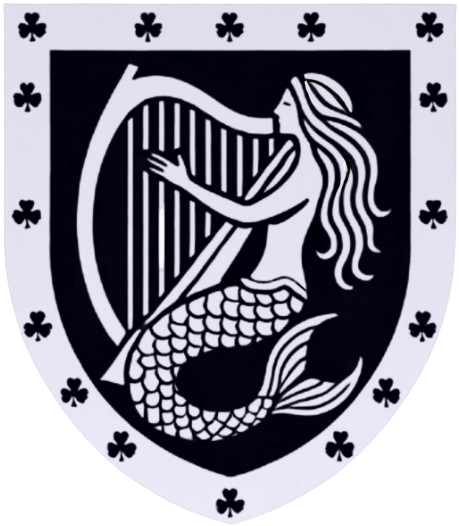
The arms of Clan Ó Comáin feature the mystical mermaid of Newhall Lake, playing an Irish harp — symbolising traditional Irish music in the clan's heritage. The mermaid is surrounded by shamrocks representing the protection of the Holy Trinity, the clan's patron saint, and its deep ecclesiastical heritage.
The harp — Ireland's oldest heraldic symbol — reflects the clan's deep roots in the Gaelic musical and cultural tradition of County Clare, a county renowned throughout the world for its traditional music. The shamrock border binds the design to the clan's spiritual patron, Saint Commán — founder of Roscommon and Kinvara.
Only registered clan members are approved by the Chief to use the clan's crest and coat of arms on personal items, stationery, jewellery and ceremonial objects — including signet rings, bookplates, embroidered goods, engraved silverware, tombstones and vehicle insignia. Membership is open to all who love Irish culture and heritage, wherever in the world they are.
Three coats of arms are associated with the Commane / Comyn / Cummins name. Understanding what each one actually is — and which belongs to the Irish Clan Ó Comáin — is essential for any clan member researching their heraldic heritage.
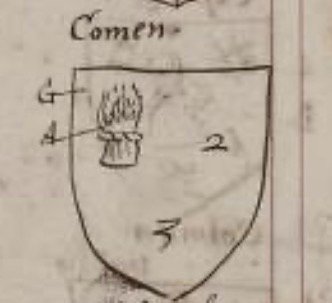
A shield labelled "Comen" appears on page 83 of an Ulster King of Arms manuscript dated approximately 1650, within the alphabetical sequence of C-surnames in the volume. This is the document most often cited as evidence of a Commane coat of arms.
Comen is not a documented Irish surname — it appears in none of the standard registers (MacLysaght, Woulfe, O'Hart). The standard 17th-century anglicisations of the Gaelic Ó Comáin in active use in Clare were Coman, Cowman, Commane, Commin, Commyn and Comyn. The most plausible reading is therefore that the scribe misspelt or idiosyncratically rendered one of these — most likely Coman or Comyn, both phonetically and visually close to Comen. Heraldic visitation books of this period were compiled by English-speaking heralds working from oral information, often through interpreters, and surname-spelling drift across folios is well documented.
On careful examination, the arms drawn on the shield are visually similar to the standard Comyn garb arms. Two readings of this are possible. The conservative reading is that a 17th-century clerk assigned the well-known Norman Comyn arms to a phonetically similar Gaelic name without further investigation. The alternative reading — strengthened by recent Y-DNA evidence corroborating MacLysaght's identification of the Clare Comyns as Gaelic-anglicised rather than Norman-descended — is that the Clare Ó Comáin / Coman line had itself adopted late-medieval armorial practice within the broader Comyn heraldic tradition during the centuries between the 13th-century dispossession and the 17th-century manuscript. Either reading sits within the wider pattern of Gaelic Irish kindreds adapting to the late-medieval Anglo-Norman heraldic world.
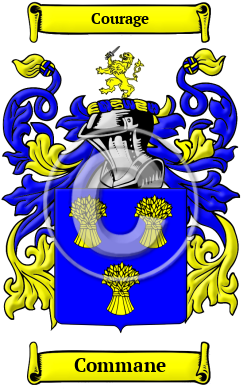
NLI catalogue · vtls000540616 ↗The arms of the House of Comyn — Lords of Badenoch and Earls of Buchan — bear Azure, three garbs Or (blue field, three golden sheaves of wheat). This is the great Scottish-Norman dynasty descended from the de Comines family of Flanders. Their arms have nothing to do with the Gaelic Ó Comáin clan.
The garbs are in fact sheaves of cumin herb — a visual pun (canting arms) on the name Comyn/Cumin. The similarity of name to the Gaelic Comáin is purely phonetic; the families are entirely unrelated.
House of Comyn · WappenWiki ↗
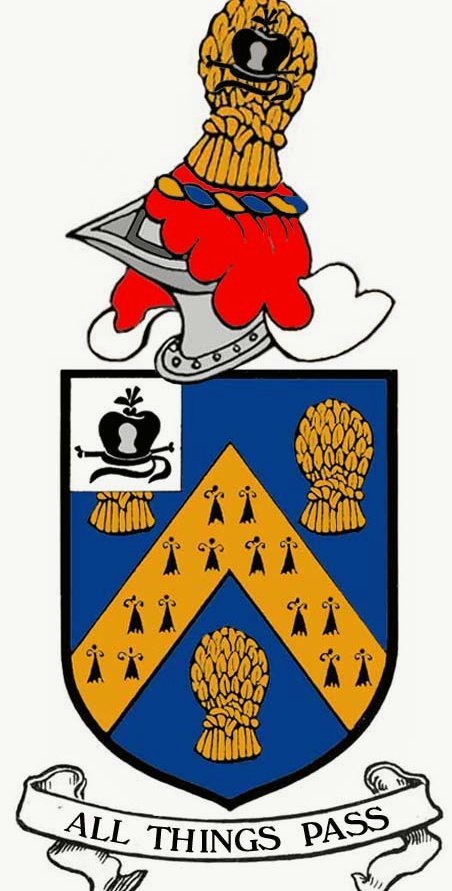
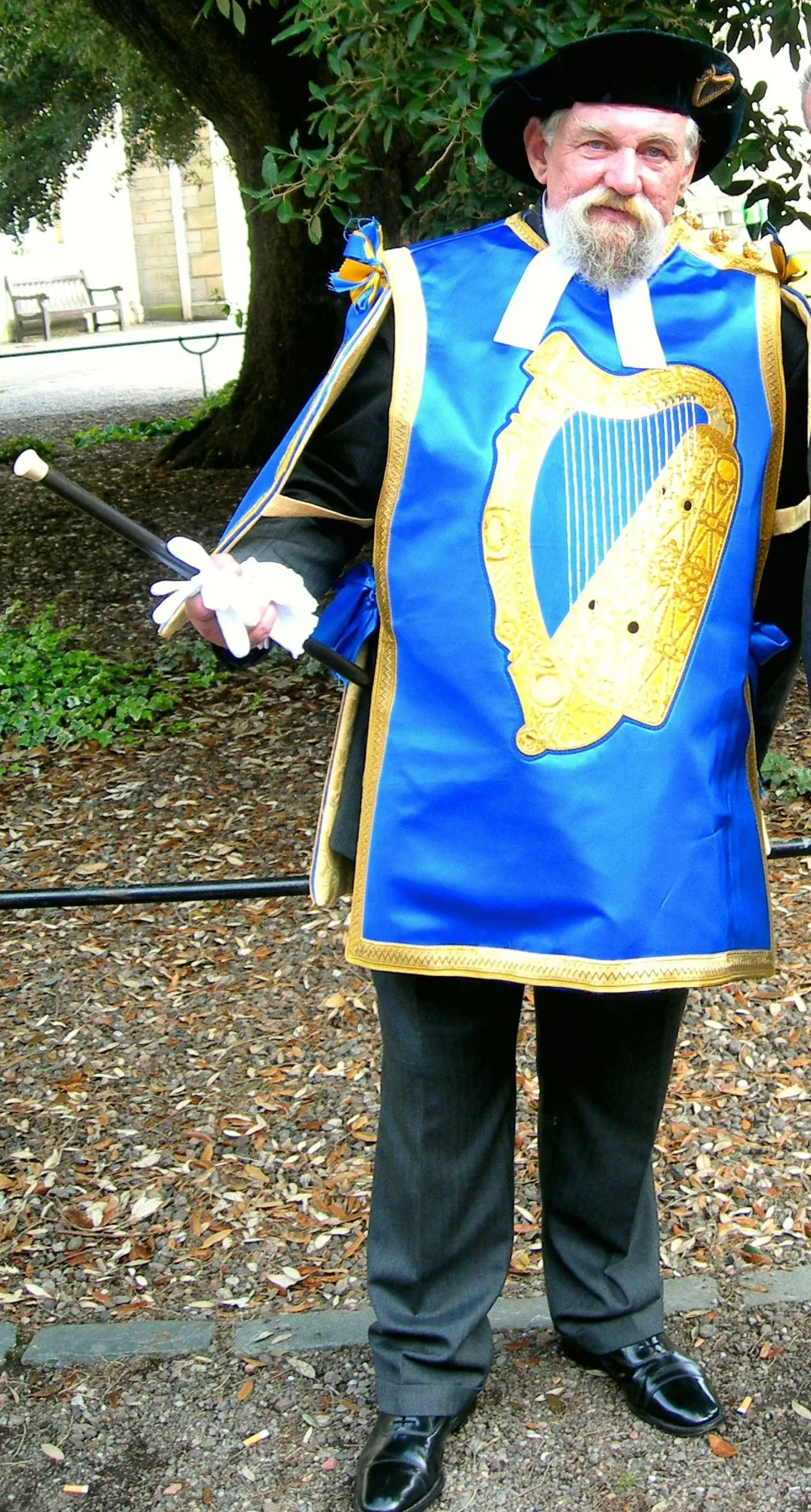
The personal arms of Micheál Ó Comáin (born Michael Cummins) — who served as Herald of Arms at the Office of the Chief Herald of Ireland and bore the Ó Comáin name in its Irish form. His arms feature garbs, consistent with the broader Comyn heraldic tradition.
His family rendered the name variously as Comyns, Cummins and Ó Comáin — illustrating precisely the centuries-long blurring of the Gaelic and Norman traditions. His arms represent the most direct example of the Ó Comáin name bearing arms in the modern Irish heraldic tradition.
More about Micheál Ó Comáin ↓
Micheál Ó Comáin served as Herald of Arms at the Office of the Chief Herald of Ireland — the national authority on heraldry — and as a consultant herald who devised arms for other Irish families, including the Genealogical Society of Ireland. His family had rendered the name variously as Comyns, Cummins and Ó Comáin.
Notably, Micheál Ó Comáin himself bore arms featuring garbs — consistent with the Comyn heraldic tradition — reflecting the centuries-long blurring of the Gaelic and Norman traditions that makes the heraldic question of the Ó Comáin name so complex. He also confirmed to researchers that the Office's records prior to 1691 are incomplete, making definitive statements about pre-1691 Gaelic arms particularly difficult.
A historically important point first: coats of arms did not exist during the period when the Ó Comáin sept was at the height of its power. The Chiefdom of Tulach Commáin flourished in the 8th and 9th centuries AD. Coats of arms as a formal heraldic system did not begin to develop anywhere in Europe until the 12th century, arriving in Ireland only with the Norman invasion after 1169. There can therefore be no surviving authentic Gaelic-period arms for the Clan Ó Comáin chiefdom, because none existed.
What does survive is evidence of a late-medieval armigerous tradition for the Clare Comyn line — the same line, per MacLysaght's reading and the Y-DNA evidence, as the Gaelic Ó Comáin sept under their anglicised Comyn name. The 1650 Ulster King of Arms entry recording arms for "Comen" — most plausibly a scribal misspelling of Coman or Comyn, since Comen is not a documented Irish surname; Sir William Comyn, knight (c. 1440), recorded as ancestor of the Comyns of Corcomroe and Kilcorney in the Burren; and the formal pedigree of this family registered with the Ulster King of Arms in 1748 — all attest that, by the late-medieval period, the Clare line had taken its place within the Anglo-Norman heraldic order under the Comyn anglicisation. These are not 8th-century Gaelic arms; they are 15th-to-18th-century arms borne by the Gaelic line during the centuries of Comyn-anglicisation that followed the dispossession.
Even the Kavanaghs — one of the most powerful Gaelic dynasties in Leinster — when seeking a formal grant of arms in 1582 declared that they were "uncertain under what sort and manner their predecessors bore the said arms" and had to request the Ulster King of Arms to assign arms to them entirely afresh. The dispossessed Gaelic families typically lost the institutional memory of any pre-heraldic emblems they may have used, and adapted to the late-medieval Anglo-Norman heraldic world as they could.
Numerous commercial heraldry websites sell prints, plaques and jewellery bearing a variation of the Norman Comyn arms — blue and gold sheaves — labelled as the "Commane," "Cummins" or "Comyn" family coat of arms. These have no authentic connection to the Irish Clan Ó Comáin and are Norman heraldry incorrectly attributed on the basis of phonetic name similarity alone.
Members of Clan Ó Comáin are asked not to purchase these products. The clan's authentic arms are currently pending a formal application to the Chief Herald of Ireland.
Clan Ó Comáin is pending application with the Office of the Chief Herald of Ireland for a new grant of arms. This is the correct, most prestigious and most historically honest course of action available to the clan — a living heraldic document with full legal standing, grounded in one of the most thoroughly researched Gaelic pedigrees presented to the Chief Herald's office in recent years.
The grant will incorporate elements drawn from the ancient Gaelic Ó Comáin heritage — among them the mythical mermaid of Newhall Lake, the Irish harp, and the shamrocks of the clan's patron saint. The Office of the Chief Herald recognises the concept of clan or sept arms, under which any member of the clan may display the arms — not merely the individual grantee. A grant to the Chief therefore provides a heraldic identity accessible to all members of Clan Ó Comáin worldwide.
This approach follows well-established precedent. Ancient Gaelic families whose arms were lost with their history have been granted new arms by the Chief Herald throughout the modern period, grounded in their documented noble and royal ancestry. The Ó Comáin pedigree — traceable to the Kings of Déisi Muman (the Déisi of Munster) and the royal line of Uí Maine in Connacht, documented in the Book of Lecan, the Book of Leinster and the Annals of Ulster — is among the most thoroughly documented presented to the office in recent years.
Members of Clan Ó Comáin are asked not to purchase or display the commercial "Commane arms" products sold online. These represent Scottish-Norman heraldry that does not belong to the Gaelic sept and perpetuates a historical confusion that this clan is working to correct.
Chief-approved use of the crest and coat of arms is available to registered clan members only. The story of that grant — an ancient Gaelic clan whose arms were lost with its history, now claiming its rightful place in the Irish heraldic tradition — will itself be a meaningful chapter in one of the oldest and most remarkable clan stories in Ireland.