Ireland's origin story · told from the beginning
Myth
From the first man to the high kings of Tara — the inheritance kept alive in vellum manuscripts for nine hundred years, told here from the beginning.
From the first man to the high kings of Tara — the inheritance kept alive in vellum manuscripts for nine hundred years, told here from the beginning.
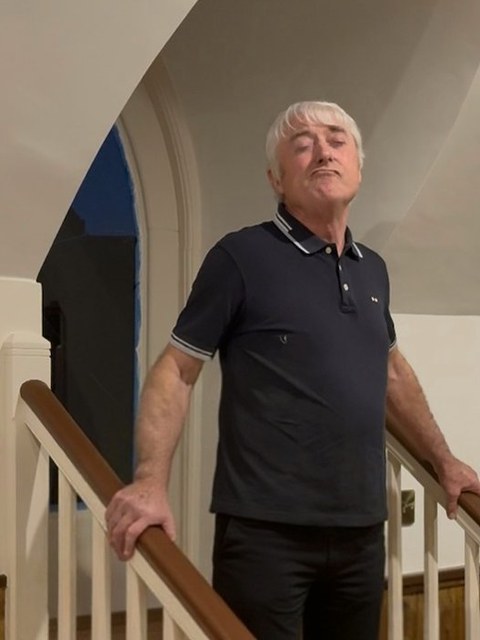
In the Gaelic tradition the seanchaí was the keeper of memory — the one who held the stories, the genealogies and the lore of the people, and told them aloud so they would not be lost. Paddy carries that office for the clan; what follows is the oldest story of all, told as he tells it.
What follows is not a history textbook. It is the story Ireland tells about herself — the way every people remembers itself before the historians arrive.
It begins with Adam and Eve. It passes through scholar-kings on the Black Sea steppe, through a sojourn in Egypt at the time of Moses, through a tower in Galicia whose stones still stand. It arrives in Ireland on a fleet of ships from Spain. And it tells of the people who were here before the Gaels — a people who became, in the end, the fairy folk you grew up hearing about.
This story was set down in the eleventh century, in a book called the Lebor Gabála Érenn — the Book of the Taking of Ireland. The monks who wrote it down were preserving what had been carried in memory for centuries before them. Some of it is myth. Some of it shades into history. The line between the two has always been the most interesting place to stand.
The eleventh-century monks who set this story down traced every noble Gaelic line in Ireland — Clan Ó Comáin among them — back through Milesius to the first man. Today, DNA confirms what the monks chronicled — an unbroken patriline carrying the same noble Gaelic inheritance into the present.
The medieval chroniclers who set this story down were writing in a monastery, by candlelight, in the eleventh century. They were Christian monks. The world they understood began with Adam, and ran through the generations of the Bible to Noah, and from Noah onward into the wider human family. When they came to set down the older Irish traditions they had inherited from the bards and the keepers of memory — traditions much older than any monastery — they did what every people does with its inheritance. They reconciled it. They wove the older Irish story into the chronology they knew.
So the Irish story, as we now have it, begins with Adam.
It moves quickly through the early generations: Cain and Abel, the line of Seth, the long-lived patriarchs whose names — Methuselah, Lamech — survive in English as quietly as the names of streets. The world fills with people. The world goes wrong. And then the Flood arrives.
Of all of human kind, only Noah and his three sons survived: Shem, Ham, and Japheth. From Shem came the Hebrews and the Arab nations. From Ham came the peoples of Africa. From Japheth came the northern peoples — the Greeks, the Celts, the Germans, the Slavs, the Romans, the peoples of the British Isles, and the people whose story this is.
The Irish, in the medieval imagination, are children of Japheth.
This matters because it sets a frame for everything that follows. The story Ireland tells about herself is not parochial. It is not the story of one obscure island, set apart. It is the story of a kindred who walked off the ark with the rest of the human world, kept their own particular memory through the long centuries that followed, and ended up — by ways the next section will tell — at the edge of Europe, on the western sea.
The Flood is the hinge. Before the Flood, the world was one thing. After the Flood, the world began again. And our story begins with Japheth stepping off the ark, looking at a wet new world, and beginning to walk north.
Japheth had seven sons. The one whose line our story follows is Magog. Magog's people went east, settled on the great open steppe north of the Black Sea, and became horsemen and herders. The Greeks who later met them called them Scythians. They were the men in conical hats and embroidered trousers you see in classical reliefs, riding without saddles, drawing short bows backward over the rumps of their horses. For long centuries this was the world the kindred lived in. They moved with the seasons. They buried their kings under heaped earth. They fought everyone and they remembered every fight.
And then, in this kindred — at a time the chroniclers place not long after the Tower of Babel — a man was born called Fénius Farsaid.
Fénius was a king's son, but he was not a king's son who wanted to rule. He wanted to understand. The recent disaster at Babel had broken human language into seventy-two scattered tongues, and the world was, to him, suddenly less knowable than it had been. He sent for the brightest minds of his own people. When he had gathered them, he founded a school, and announced what he intended.
This took years. The students walked or sailed to the far places of the known world. Some of them died. Some of them came back with strange wives and stranger habits. But they came back. They sat down with Fénius — now an old man, by the chroniclers' reckoning — and one by one they laid before him what they had learned. Seventy-two tongues, spread out on the table of one school.
And then Fénius did something that no one before him had done. He went through the seventy-two languages, and he took the best of each — the most musical sounds, the most useful grammatical bones, the most precise words for the things that matter — and he wove them all together. From the seventy-two tongues, he made one.
He named it after his son, Gaedheal. The language was called Gaeilge. We call it Gaelic, or Irish.
This is the foundation myth of the Irish language — that it is, by design, the deliberate weaving-together of every human tongue, made by a Scythian philosopher-king as a gift to the people who would carry it. Whether it actually happened the way the chroniclers tell it is not the point. The point is that this is the story Irish-speakers have told themselves, for a thousand years, about why their language sounds the way it does. The reason the words feel layered. The reason the sentences have music in them. The reason every Irish poem feels like it knows something.
It is the language Fénius wove.
And the kindred who carried it west, generations after his death, who eventually arrived at the edge of the world and gave their name to the green island they found there — they are the Gaels. The people of Gaedheal's tongue.
But they did not go straight from the Black Sea to Ireland. The journey was long, and the next stop was a strange one.
The kindred did not stay on the steppe. Some hundreds of years after Fénius, the line had moved south — into Egypt, where the chroniclers place them at the time of Moses. Some versions of the story say the Gaels helped Moses against Pharaoh. Some say they were exiled with him from Egypt and made their own way. One of their princesses, Scota, gave her name — much later — to a kingdom on a colder island. In Latin, Scoti means the Irish: the people of Scota's line. It was the Irish who crossed the narrow sea in the early centuries of the Christian era, settling in Argyll and founding the kingdom of Dál Riata. Their kingdom grew. Their name travelled with them. The land they settled took on their name, and the country we call Scotland today carries the name of an Egyptian princess and the people who came from Ireland to claim it.
From Egypt they wandered. The chroniclers trace them through Crete, through Sicily, along the Mediterranean coast, always moving west, always looking for the place where their people would finally be at home. They were not yet at home. Generations passed. Kings rose and died and were buried in lands that did not belong to them. The story does not say what they were searching for. It says only that they kept moving, and that one generation after another, the elders told the young: this is not yet our place.
They came at last to Galicia, in the far northwestern corner of Spain — wet green country, looking out across the Bay of Biscay to a sea that seemed to lead nowhere. Here, finally, the kindred stopped. They built a kingdom. The king of that kingdom was a man called Breogán, and he gave his name to everything that followed.
Breogán was a builder. He built a great city, called Brigantia. And in the middle of the city, he built a tower — taller than anything the kindred had built before. It was a lighthouse, in part. Its purpose was to guide ships into the harbour. But it was also a watchtower, and on a clear day, from the top of Breogán's tower, you could see things that were very far away.
One of Breogán's sons, a man called Íth, climbed the tower one winter evening, and looked out. The sun was setting in the northwest. The sea was clear. And on the horizon, in a quarter where no land was supposed to be, Íth saw a faint green line.
He came down. He told his father what he had seen. The kindred had been moving for centuries, and here at last, on the horizon, was a land they had not yet been to. A land none of them had any claim to. A land that was waiting.
This is the moment the kindred finds Ireland.
It is in the city of A Coruña, in Galicia, on the same windy headland where the Lebor Gabála places it. It is called the Tower of Hercules, because the Romans renamed it after they reached northern Spain and adopted the tower for their own use. UNESCO has it as a World Heritage site. It is the oldest still-functioning lighthouse anywhere in the world. Ships are guided into A Coruña tonight by a light that shines from a tower a Roman emperor rebuilt on a foundation that, in Irish memory, belonged to Breogán.
You can fly there. You can climb the tower. From the top, looking northwest across the Bay of Biscay, on a clear day, you can almost — almost — imagine what Íth saw.
The kindred made ready their fleet. They were going home to a country they had never been to.
The sons of Míl set sail from Galicia in a fleet of sixty-five ships. They had been preparing for years. Their father, Míl Espáine — Míl of Spain — had died before he could lead them, and so it fell to his sons, and to his widow Scota, the Egyptian princess whose name the country of Scotland still carries. They were a kindred of farmers and warriors and poets and druids. They were sailing for the green land their grandfather had seen from the top of Breogán's tower. They were sailing for Ireland.
The land was not empty.
The people already there were called the Túatha Dé Danann — the People of the Goddess Danu. They had arrived in Ireland generations earlier, from somewhere further north, in ships or in clouds — the storytellers never quite agreed. They were a people of extraordinary skill. Their craftsmen could make weapons that never missed their mark. Their physicians could bring the dead back to life. Their poets could shape the weather with a verse. They had four great treasures with them: the Stone of Destiny, which cried out when a true king touched it; the Spear of Lugh, which never lost a fight; the Sword of Núada, which no one could escape once it was drawn; and the Cauldron of the Dagda, which never ran empty. When the Milesian fleet arrived, the Túatha Dé were the people of Ireland.
What happened next is the strangest and most beautiful moment in Irish mythology.
The Milesians could not land. As they approached the coast, the druids of the Túatha Dé raised a storm out of nothing — a storm so violent it swept the ships back to sea and killed many of them. The survivors regrouped. They came back. This time their own poet, Amergin, the eldest of Míl's sons, stepped onto Irish soil first, and he sang. The song he sang is one of the oldest poems in the European tradition. It begins:
The storm fell still. The Milesians made landfall.
What followed was not a war of extermination. It was a settlement — and this is the part most worth pausing on, because it is the part that explains the next two thousand years of Irish stories.
The Milesians won the battles, and they took the surface of Ireland. The Túatha Dé were defeated. But they did not leave, and the Milesians did not destroy them. Instead, an agreement was made. The Milesians would have the world above the ground — the fields, the forests, the rivers, the kingdoms, the high seats. The Túatha Dé would have the world below. They would retreat into the hills and the burial mounds and the lakes and the deep places — the sídhe, the otherworld — and they would remain there, alongside the world of the Gaels but no longer visible to it. They would become, in time, what they have been ever since.
The fairy folk. The good people. The wee folk your grandmother told you not to disturb. The sídhe who haunt the burial mounds. The mermaids in the lakes. The leprechauns under the hawthorn trees. The merrow and the banshee and the pooka. The whole magical Ireland that survives in nursery stories and old films and the songs you half-remember from someone who half-remembered them from someone before.
All of it is the same thing. All of it is the Túatha Dé Danann, retreated into the hills.
This is the moment most people don't realise when they think about Irish mythology. The fairies are not separate from the foundation story. They are the foundation story. The Disney animations of pots of gold and the postcards of leprechauns and the great-aunt who left out a saucer of milk for the wee folk — these are not folklore detached from history. They are the living afterlife of the people who held Ireland before the Gaels arrived, and who agreed to share it on the strangest of terms.
If you have ever been told a fairy story by someone who half-believed it, you have already heard the end of this section.
With the Túatha Dé Danann gone under the hills, the kindred of Míl turned to the business of holding the surface of Ireland. There were two men left to do it. Míl had been the patriarch; his sons were now the rulers. Two of them survived the landing. They were brothers, and their names were Éber Finn and Éremón.
The brothers did the thing brothers do at the end of a great venture. They argued. Each wanted to be king of the whole island. Neither would yield. In the end they agreed to divide Ireland between them. Éber Finn took the south — the rich lands of Munster, the fertile country around the Lee and the Blackwater. Éremón took the north — Connacht and the country that runs up to the wild Atlantic edge. This was the first political division of Ireland. It is older, by the Gaels' own reckoning, than Rome.
Éber Finn did not last long. He wanted more than his half. He marched against his brother, and Éremón killed him in battle, and the north and south came together again under a single king. So the line of Éremón ran on, and the line of Éber Finn ran on, and the kingdom they shared was held by their sons and grandsons in turn, generation by generation.
The seat of the high king was the Hill of Tara, in what is now County Meath. It is a low green hill in the middle of the country. To stand on it now, on a summer evening, with the sheep below and the wind in your face and Ireland rolling out in every direction, is to understand why the kindred chose it. From Tara you can almost see the whole island. From Tara the high king ruled.
And on the top of Tara, set into the earth, was a stone the Túatha Dé had left behind when they went under the hills. It was the Lia Fáil, the Stone of Destiny — one of the four treasures. The stone had a peculiar property. When the rightful king of Ireland touched it — when a true high king was being inaugurated — the stone would cry out. A clear ringing sound, audible across the hill, audible perhaps over the whole country. It was the land's own way of saying: yes. This man. This one.
For a long line of kings, the Lia Fáil sang.
Most of those kings are names now, only names. But there are exceptions. There is one in particular, in the second century after Christ, who matters for the story this page is leading toward. His name was Conn Cétchathach — Conn of the Hundred Battles — and he was high king at Tara in a generation when the older world was beginning to give way to the world we recognise as historical.
Conn was a fighter. The Hundred Battles in his epithet is probably an exaggeration, but only a slight one. The annals remember him as the king who held the whole island together at a moment when it might have broken apart. Out of his line came the dynasties that ruled the great kingdoms of medieval Ireland — the Uí Néill in the north, the kings of Connacht in the west, the Eóganacht in the south. Almost every Irish royal house that the historians later wrote about, traced itself back through Conn.
And it is at Conn — and the generation after Conn — that our story, the story of this clan, parts ways from the shared inheritance and becomes a specific story with two specific paths.
This is the fork.
After Conn of the Hundred Battles, the shared story ends, and the specific story begins.
The line of Éremón — the elder brother, the holder of the north — produced, through Conn's descendants, the great Connacht dynasty of the Uí Maine. They were a kindred of warrior-kings in the lands east of the Shannon, between Galway and Roscommon, and one of their great manuscripts — the Book of Lecan — preserves a genealogy that includes the segment called Clann Comáin. This is one of the two roots from which the modern clan grew. The Book of Lecan was compiled in the early fifteenth century, but the genealogies in it were copied from older books, and those older books were copied from older books still. The names go back. They go back to the time of Conn and beyond.
The line of Éber Finn — the younger brother, the southern king — produced the kingdoms of Munster. And in the southwestern corner of Munster, on the rocky cliff country of north Clare, a frontier people held the marches between two kingdoms. They were the Déisi Muman, the southern Déisi. The annals — the Annals of Inisfallen, the Annals of Ulster — preserve them as a warrior kindred who lived hard and held their ground. From this kindred came the historical line of Mac Comáin kings, whose fort at Cahercommane still stands today as a stone ring on the cliff edge above the Burren. This is the other root.
So the modern clan is heir to two parallel traditions. A Connacht inheritance, carried in a fifteenth-century manuscript. A Munster inheritance, carried in the annals and the stones. Both are real. Both are old. The genealogists who try to make them into a single line, or to choose one over the other, are missing the point. The clan is what holds both.
It closes here because the question this page set out to answer is not which fork is the right fork. The question this page set out to answer is whose story this is.
And the answer the page has been building toward is this. The story is not closed. It does not belong only to the people whose surnames descend in a straight line from Conn's grandsons. It belongs to whoever feels it to be theirs. To carry a story — to learn it, to retell it, to keep it from being forgotten — is itself an inheritance. It is the inheritance the medieval monks took up when they sat down to write the Lebor Gabála. It is the inheritance every Irish-American grandmother has been passing on every time she begins a story with "now my mother used to say". It is open. It has been open for a thousand years.
And the gate, as it happens, has a mermaid on it.
If the story ended in the eleventh century, when the monks first set it down in the Book of Invasions, this page would be a long footnote. But the story did not end there. It has been carried — in songs, in nursery rhymes, in the names of children and the names of lakes — for a thousand years since. It is still being carried now.
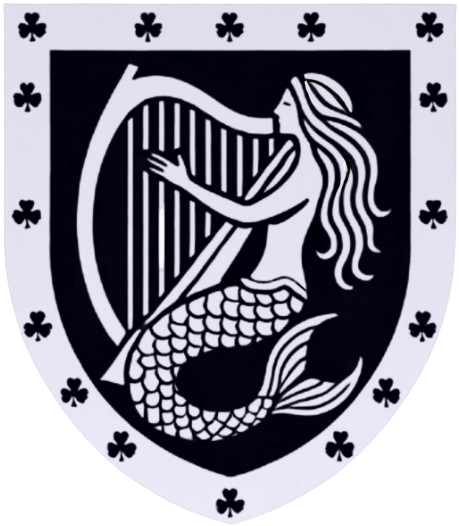
You can see it on the clan's own coat of arms. The figure in the centre is a mermaid — the mystical guardian of Newhall Lake, in the household's seat in County Clare. She is one of the Túatha Dé. She is the same kindred as the wee folk and the sídhe and the fairies in your grandmother's stories. She is playing an Irish harp — for the music of the line. She is surrounded by shamrocks — for the protection of the Holy Trinity, and for Saint Commán, the clan's patron, who is the bridge between the older pagan inheritance and the Christian one that came after.
The mermaid is still on the gate at Newhall. The kindred still gather under her. The story is not finished.
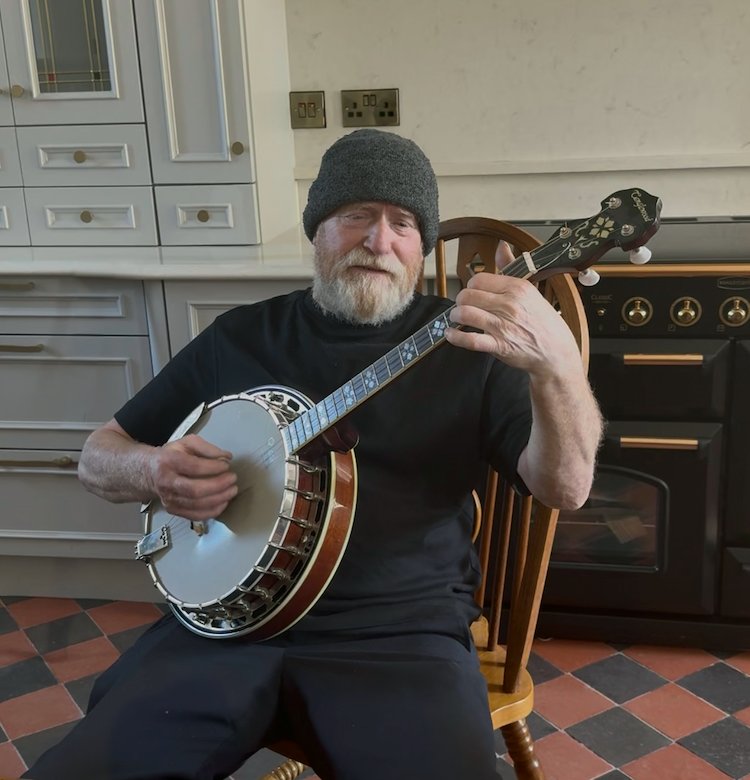
People assume you need the name to belong to a clan. You don't — and you never did. A clan was never one family; in the old Gaelic order it was a túath, a small nation joined by allegiance and place, in an age before surnames even existed.
So Clan Ó Comáin is not surname-gated. No particular name, no Irish grandparent, no line of descent to prove. If you love Ireland, you belong here — take your place on the Register and become a Founder of the revival.