Ó Comáin
A genuine Gaelic coat of arms
Authentic Irish arms — not a "family crest" sold online
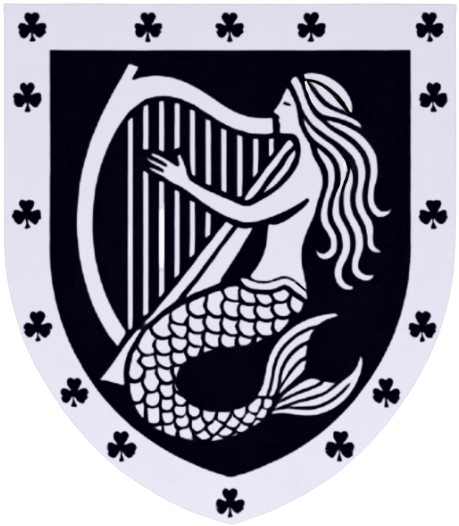
The coat of arms of Clan Ó Comáin is a genuine heraldic design drawn from the Gaelic royal tradition and recognised through the office of the Chief. It carries the mermaid of Newhall Lake, the Irish harp, and the shamrocks of the clan's patron saint, Saint Commán — the three leaves of the shamrock representing the Holy Trinity in the Gaelic Christian tradition. None of this symbolism appears on the generic "family crest" products sold online under this surname.
Under the ancient Gaelic custom of clan arms, only registered members of Clan Ó Comáin are approved by the Chief to display the arms on personal items, stationery, jewellery and ceremonial objects. The arms belong to the clan; their use is a right extended by the Chief to those whose names are entered on the Register at Newhall House.
Who was Coman — and where does the name come from?
The personal name Coman is among the oldest recorded in Irish history. In the case of Clan Ó Comáin, its earliest documented bearer is Coman, son of Breanan Dall — the 12th King of Uí Maine, whose own death is recorded in the Annals of Ulster at 597 or 601 AD. From this Coman, living in the late 6th and early 7th centuries, the surname Ó Comáin — meaning "descendant of Coman" — was born. Over the following twelve centuries it was gradually anglicised into Cummins, Commins, Commons, Commane, Comyn, Hurley and many other forms.
The name was also borne by at least twelve Irish saints, the most celebrated of whom was Saint Commán of Roscommon — also recorded as Coman — who founded the monastery of Ros Commáin ("Coman's wood") and whose death is noted in the Annals of Ulster at 747 AD. His feast day, 26 December, is still observed in the diocese of Elphin today. The convergence of a saint's name, a family name, and a chiefdom's name in a single word was not accidental: in early medieval Ireland, such names traveled together.
Coman as a surname is uncommon in Ireland today — most who once carried the Gaelic Ó Comáin have, over four centuries of anglicisation, become Cummins, Commins, Commons, Commane, or Comyn. The Irish Coman and the Romanian Coman are homonymous but etymologically unrelated: the Romanian form derives from a distinct linguistic root. Within Ireland, however, the name belongs unambiguously to the Gaelic naming tradition — a personal name before it became a family name, a saint's name before it became a chiefdom's name.
Whether you carry the name Coman through Irish descent, through a Romanian family line, or through any other route — if you feel the pull of ancient Celtic culture, this clan is open to you. The name Coman has been sacred in Ireland for over 1,400 years.
The twelve saints named Coman — and the places they left behind
The proliferation of saints named Coman in medieval Ireland gives the name a density of sanctity matched by few others. The most prominent figures:
Saint Commán of Roscommon (d. 747 AD) — founder of the monastery of Ros Commáin from which the county, the town, and the diocese derive their names. He is the patron saint of Roscommon, and his cult extended throughout medieval Connacht.
Saint Coman of Kinvara — identified in the Dictionary of National Biography (1887) as the same person as the saint of Roscommon. The entry records that he "also founded the church of Ceann Mara, now Kinvara" on the southern shore of Galway Bay, within sight of the Burren heartland of the Chiefdom of Tulach Commáin. That the founding saint of the region was later mirrored in the chiefdom's name is a convergence that cannot be coincidental.
Other Irish saints named Coman appear in the martyrologies and annals across the 6th to 9th centuries, including abbots and ecclesiastics at Glasnevin, Roscarbery, and various foundations in Connacht and Munster. The name was particularly favoured in religious houses: as with Colmán, Brendan, and Ciarán, Coman belonged to a vocabulary of names that carried authority within the early Irish church.
The name Coman is therefore inscribed into the Irish religious and civic landscape more deeply than its modern rarity suggests. It is the name of a county (Roscommon), a town (Roscommon), a medieval townland (Cahercommane in Clare), a parish tradition (Kinvara), and a 7th-century royal lineage whose descendants — across every anglicised spelling — live today in every English-speaking country on earth.
The name Coman in Irish annals and manuscript tradition
The name Coman appears across the surviving corpus of medieval Irish manuscript genealogies with notable frequency. In the great 15th-century Book of Lecan — compiled at Lecan in County Sligo by the Mac Fir Bhisigh hereditary scholars — Coman appears as an ancestor in the Uí Maine royal pedigree, positioned as the son of Breanan Dall and thereby the originating figure from whom the surname Ó Comáin descends.
In the Annals of Ulster — compiled at Belle Isle in Upper Lough Erne in the late 15th century from earlier sources — entries record at least three individuals named Coman in the 7th and 8th centuries: Coman mac Breanan Dall (implicit in the entry for his father's death), Saint Commán of Roscommon (d. 747), and further abbatial and secular figures. The name was not uncommon in the royal and ecclesiastical circles of early medieval Ireland, suggesting it carried significance among the families who chose to bestow it.
The 19th-century genealogist John O'Hart, in his Irish Pedigrees (5th edition, 1892), recorded the Ó Comáin lineage tracing through Coman back to the royal line of Uí Maine — a pedigree that links the modern clan to one of the great Gaelic dynasties of Connacht, documented in primary Irish manuscript sources and still accessible to researchers today.
King Suibne mac Comáin — the Déisi Muman inheritance
Beyond the Uí Maine royal line in Connacht, the name Comán enters the historical record through another commanding figure: King Suibne mac Comáin of the Déisi Muman (the Déisi of Munster), who died in 658 AD. His entry in the Annals of Ulster places the lineage of Ó Comáin among the ruling kindreds of a distinct early medieval Gaelic kingdom within Munster. His son, Congal mac Suibne, who also held the kingship of the Déisi, died in 701 AD.
The Déisi Muman were not the provincial monarchs of Munster — that title was held by overlord dynasties such as the Eóganachta and, later, the Dál gCais. The Déisi Muman were a distinct kingdom within Munster, with their own territory, their own kings, and a political weight substantial enough to appear repeatedly in the primary sources. Whether the Suibne mac Comáin of the Déisi Muman and the Coman of the Uí Maine royal line in Connacht represent one connected family or two independent lineages sharing the same personal name remains an open scholarly question — both traditions are presented on the clan pedigree honestly.
The origin of the Déisi Muman as a people is itself preserved in medieval Irish literature. The Old Irish narrative The Expulsion of the Déisi (Indarba na nDéisi) records that the kindred was forced out of the Tara region of Leinster — following a dispute during the reign of the High King Cormac mac Airt — and eventually settled in Munster, where they formed an alliance with the Eóganachta to secure their territory. This is the political background from which Suibne's kingship was later exercised.
Further evidence for the Comáin family's extent is preserved in the Annals of Inisfallen, which record the death of Colmán mac Comáin on the Aran Islands in 751 AD — described in the martyrology Félire Óengusso as a bishop of Munster and one of the four sages of Ireland. His probable brother, Célechair mac Commáin, was killed at the battle of Corcu Modruad in 705 AD. D. Blair Gibson, in From Chiefdom to State in Early Ireland (Cambridge University Press, 2012), proposed that the Aran Islands may have fallen within the territory of the Chiefdom of Tulach Commáin itself. Claire Cotter, in the Discovery Programme's Western Stone Forts Project monograph (2012), separately suggests that the brothers' father may have held the chiefship — the sub-king Commán after whom Cahercommane is named. Whether the chiefdom belonged within the Déisi Muman political sphere — as the documented kingship of Suibne mac Comáin over the Déisi Muman would suggest — or within a distinct Uí Fidgeinti sub-lineage as Cotter proposes, remains part of the open scholarly discussion presented on the clan pedigree. Suibne mac Comáin is further referenced in the Déisi Genealogies, in Rawlinson B 502, and in the great medieval manuscript compilations of Irish genealogy — the Book of Lecan and the Book of Leinster — establishing the figure firmly within the primary sources of Gaelic historical record.
The territorial imprint of the name Comán survives in the Irish landscape today. The great stone fort of Cahercommane on the Burren is the best-known monument, but Commane place-names across Kerry and Cork — from townlands to church sites and smaller holdings — mark the wider Munster reach of a family whose name passed, across the 17th, 18th and 19th centuries, into every anglicised spelling now recognised as a variant of the original.
Cahercommane — the name of Coman written into stone
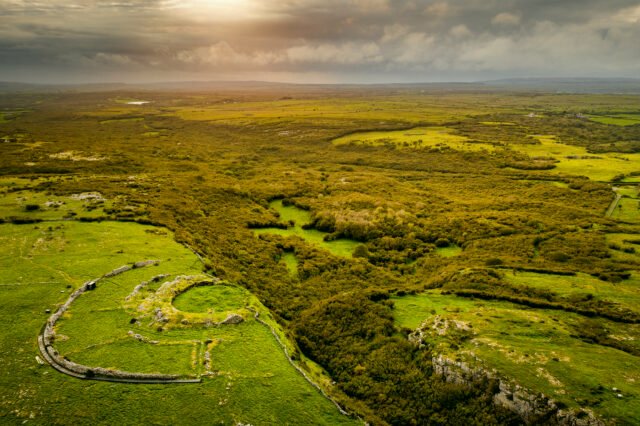
The most enduring inscription of the name Coman into the Irish landscape is the great stone fort of Cahercommane — Cathair Chomáin in Irish, literally "Coman's stone fort" — on the cliff edge of the Burren in County Clare. Built in the 8th or 9th century as the ceremonial capital and inauguration site of the Chiefdom of Tulach Commáin, it is one of the most structurally remarkable ancient sites in Ireland.
The fort's triple-ring design — three concentric stone walls enclosing a central platform — is rare in Irish archaeology, and its scale and position on the Burren escarpment suggest a site of considerable political importance. The Harvard Archaeological Expedition excavated Cahercommane in 1934, producing detailed plans and recovering early medieval artefacts that established the site's antiquity and function. In 2012, the archaeologist D. Blair Gibson published From Chiefdom to State in Early Ireland (Cambridge University Press), a monograph analysing Cahercommane as the political centre of a functioning early medieval chiefdom — not merely a defensive fort, but the seat from which a named family, the Ó Comáin, governed a documented territory.
To stand at Cahercommane today — a dozen miles from the Atlantic cliffs of the Burren, on the limestone pavement of north Clare — is to stand at the place where the personal name Coman became a political identity. It is there that the saint's name, the family name, and the chiefdom's name converge in stone. The heartlands of the clan, including Cahercommane and the modern seat at Newhall House, remain open to members.
From Coman to every anglicised variant — how the name travelled
The personal name Coman is the ancestor, in both the genealogical and the linguistic sense, of every anglicised variant that followed. Every Cummins, Commins, Commons, Commane, Comyn — and for certain Clare and Cork families, Hurley — descends from Coman, son of Breanan Dall.
The mechanics of the anglicisation are traceable. Through the 16th, 17th and 18th centuries, as Gaelic-speaking Ireland was gradually brought under English-language administration, the Irish surname Ó Comáin was recorded by English-speaking clerks in whatever phonetic spelling they heard. The Munster Ó Comáin became Cummins or Commane (with the long 'á' pronounced like an 'aw'), while the Connacht Ó Cuimín became Commins (with a short 'i'). Edward MacLysaght, the first Chief Herald of Ireland, documented this dialectal split in The Surnames of Ireland (Irish Academic Press, 1985).
For a researcher whose family line traces through any of these anglicised spellings, the point of convergence is the name Coman itself. Beyond that, the pedigree ascends through the Uí Maine kings of Connacht into the deep Gaelic past — a lineage whose Y-DNA terminal haplogroup, R-BY14247, has now been confirmed by Big-Y testing within the wider R-L21 Celtic group — marking some 4,000 years of western Irish ancestry.
Tracing a Coman family line — a practical guide
Coman as a surname is uncommon enough in modern Ireland that a researcher often finds themselves working with unusually discrete records. For those beginning:
Start with the living memory. The great-grandparent generation's testimony about where the family came from is invaluable, and is typically the first thing lost if it is not recorded early. If you still have a relative who remembers Ireland directly, interview them now.
Trace the Irish origin parish. Civil registration (from 1864, searchable through irishgenealogy.ie) and the 1901 and 1911 censuses (through the National Archives of Ireland) will usually place a Coman ancestor in a specific parish. Catholic parish registers — digitised by the National Library of Ireland and freely searchable — extend many Coman lines back to the early 19th century.
Watch for spelling drift. In historical records, a single Coman line may appear as Coman, Comman, Commons, Commins, Comyn and Commane across different entries and generations. Parish clerks, census enumerators, immigration officials, stonemasons and priests all recorded by ear. Searching under all variants together is often essential, not optional.
Consider DNA testing. Big-Y-700 through Family Tree DNA is the gold standard for placing a male-line Coman descendant within the documented Ó Comáin pedigree. The terminal haplogroup R-BY14247, within the broader R-L21 Celtic group, connects living Coman descendants to 4,000 years of western Irish ancestry. Autosomal tests (Ancestry, 23andMe, MyHeritage) will confirm broad Irish heritage but cannot reach this surname-specific depth.
Connect with the clan. Clan Ó Comáin is open to all bearers of the name in every spelling, and to all who carry the name Coman whatever their family tradition. The Register of Members kept at Newhall House stands as the modern continuation of a documented Gaelic lineage stretching back fourteen centuries.
Frequently asked questions
Is Coman an Irish name?
Yes. Coman is one of the oldest documented personal names in Irish history. It was borne by at least twelve Irish saints, including Saint Commán of Roscommon (d. 747 AD), and by Coman mac Breanan Dall — the 7th-century ancestor from whom the surname Ó Comáin descends.
Is the Irish Coman the same as the Romanian Coman?
No — the two names are homonymous but etymologically unrelated. The Romanian Coman derives from a distinct linguistic root. The Irish Coman is a Gaelic personal name descending from the royal Uí Maine dynasty of Connacht, with saint associations and documented annalistic record.
Where did the Coman name come from?
The earliest documented bearer of the name in the Ó Comáin royal line is Coman, son of Breanan Dall — the 12th King of Uí Maine, whose death is recorded in the Annals of Ulster at 597 or 601 AD. The surname "Ó Comáin" means "descendant of Coman".
How does the Coman name relate to other Irish surnames?
Every anglicised Irish surname in the Cummins / Commins / Commons / Commane / Comyn / Hurley group descends from the Gaelic personal name Coman. Coman is the root; all the anglicised spellings are its later derivatives, shaped by regional dialect and administrative anglicisation from the 17th century onward.
Can I join the clan if my surname is Coman?
Yes. Clan Ó Comáin welcomes all bearers of the name Coman — of Irish origin or otherwise — along with all descendants of the Cummins, Commins, Commons, Commane, Comyn and Hurley variants. Membership is open to all who feel the call of Gaelic culture.
Apply for Coman / Ó Comáin clan membership