Ó Comáin
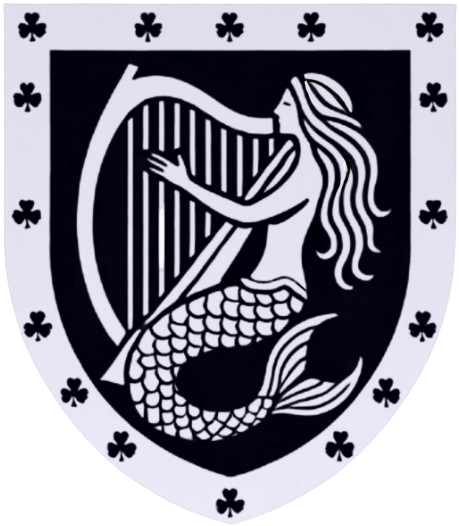
A genuine Gaelic coat of arms
Authentic Irish arms — not a "family crest" sold online
The coat of arms of Clan Ó Comáin is a genuine heraldic design drawn from the Gaelic royal tradition and recognised through the office of the Chief. It carries the mermaid of Newhall Lake, the Irish harp, and the shamrocks of the clan's patron saint, Saint Commán — the three leaves of the shamrock representing the Holy Trinity in the Gaelic Christian tradition. None of this symbolism appears on the generic "family crest" products sold online under this surname.
Under the ancient Gaelic custom of clan arms, only registered members of Clan Ó Comáin are approved by the Chief to display the arms on personal items, stationery, jewellery and ceremonial objects. The arms belong to the clan; their use is a right extended by the Chief to those whose names are entered on the Register at Newhall House.
Where does the Commons name come from?
The surname Commons is among the rarer anglicised forms of the ancient Gaelic name Ó Comáin. In Ireland, the spelling Commons is most closely associated with County Wexford, in the south-east, where Edward MacLysaght — the first Chief Herald of Ireland — recorded its concentration in The Surnames of Ireland (Irish Academic Press, 1985): "Usually called Commons in Co. Wexford and Cummins in Co. Cork." This precise dialectal distribution is part of what makes the Commons spelling so distinctive among the clan of Ó Comáin anglicisations.
The terminal -s in Commons carries the same inherited meaning as the Gaelic Ó- prefix: "descendant of". Where the Munster clan wrote themselves Ó Comáin, and English-speaking clerks in Cork and Clare heard and recorded Cummins, the Wexford branch retained a closer phonetic form — Commons — in which the "s" ending preserved the genitive sense of "of the Ó Comáin clan". The name is old: its bearers in Wexford parish registers of the 18th and early 19th centuries were often several generations distant from the last Gaelic-speaking member of the line.
Because Commons is rarer than Cummins and sits geographically separate from the main Munster heartland of the clan, many modern Commons families have been unaware of their connection to one of Ireland's oldest documented Gaelic lineages. The clan's formal revival and recognition by Clans of Ireland in 2025 opens that history to them for the first time.
The Commons name is rare precisely because it preserved the Gaelic family structure more faithfully than most anglicised forms. If you carry the Commons surname through an Irish line — particularly one with Wexford or Munster roots — your connection to Clan Ó Comáin is direct and documented.
One name, one ancient lineage — the documented history
Whether the family writes itself Commons, Cummins, Commins, Commane, Comyn or Ó Comáin, these are all anglicised — or preserved Gaelic — forms of a single name descending from a single ancestor. The earliest individually named figure in the Ó Comáin lineage recorded in primary historical sources is Coman, son of Breanan Dall, the 12th King of Uí Maine, whose own death is noted in the Annals of Ulster at 597 or 601 AD. From this Coman, living in the late 6th and early 7th centuries, the surname descends.
Through Coman's grandfather Cairbre Crom, 11th King of Uí Maine (fl. c. 556 AD), the clan shares common ancestry with many of the great Gaelic dynasties of Clare and Connacht. The O'Hart pedigree, recorded from the Book of Lecan and Book of Leinster, traces this documented royal descent through the kings of Uí Maine.
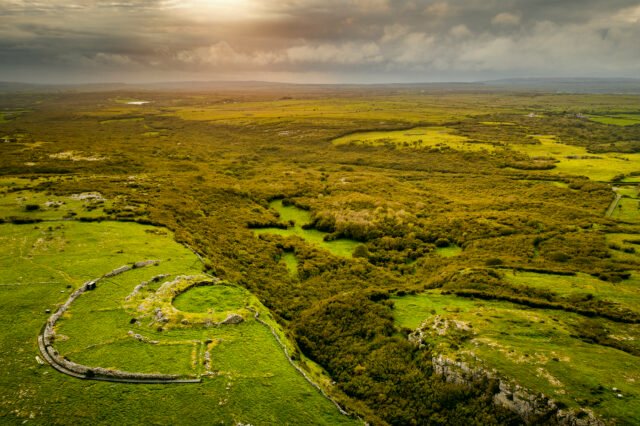
The clan held the Chiefdom of Tulach Commáin in the Burren of County Clare from the early medieval period. The great stone fort of Cahercommane — Cathair Chomáin, "Coman's stone fort" — was the ceremonial inauguration site of the chiefs, and remains standing in the Clare landscape today. The modern seat of the clan is Newhall House, County Clare, where the Register of Members is kept.
King Suibne mac Comáin — the Déisi Muman inheritance
Beyond the Uí Maine royal line in Connacht, the name Comán enters the historical record through another commanding figure: King Suibne mac Comáin of the Déisi Muman (the Déisi of Munster), who died in 658 AD. His entry in the Annals of Ulster places the lineage of Ó Comáin among the ruling kindreds of a distinct early medieval Gaelic kingdom within Munster. His son, Congal mac Suibne, who also held the kingship of the Déisi, died in 701 AD.
The Déisi Muman were not the provincial monarchs of Munster — that title was held by overlord dynasties such as the Eóganachta and, later, the Dál gCais. The Déisi Muman were a distinct kingdom within Munster, with their own territory, their own kings, and a political weight substantial enough to appear repeatedly in the primary sources. Whether the Suibne mac Comáin of the Déisi Muman and the Coman of the Uí Maine royal line in Connacht represent one connected family or two independent lineages sharing the same personal name remains an open scholarly question — both traditions are presented on the clan pedigree honestly.
The origin of the Déisi Muman as a people is itself preserved in medieval Irish literature. The Old Irish narrative The Expulsion of the Déisi (Indarba na nDéisi) records that the kindred was forced out of the Tara region of Leinster — following a dispute during the reign of the High King Cormac mac Airt — and eventually settled in Munster, where they formed an alliance with the Eóganachta to secure their territory. This is the political background from which Suibne's kingship was later exercised.
The chiefdom from which the clan descends, centred at Cahercommane, was the subject of Dr. David Blair Gibson's 1990 doctoral dissertation to the University of California, Los Angeles — Tulach Commáin: A View of an Irish Chiefdom — supervised by Prof. Timothy Earle, one of the foremost scholars of chiefdom archaeology. Gibson's work was later expanded into From Chiefdom to State in Early Ireland (Cambridge University Press, 2012). The full 1990 dissertation is available to clan members in the members' library.
Further evidence for the Comáin family's extent is preserved in the Annals of Inisfallen, which record the death of Colmán mac Comáin on the Aran Islands in 751 AD — described in the martyrology Félire Óengusso as a bishop of Munster and one of the four sages of Ireland. His probable brother, Célechair mac Commáin, was killed at the battle of Corcu Modruad in 705 AD. The lineage of these two figures remains an open scholarly question: Gibson (1990) proposed, on the basis of later medieval genealogical tracts, that they may have been of the Eóganacht Uí Cormaic, but acknowledged that a coherent case could not really be made. The documented kingship of Suibne mac Comáin over the Déisi Muman (d. 658 AD, Annals of Ulster) and of his son Congal mac Suibne (d. 701 AD, Annals of Ulster) — kings that Gibson's 1990 framing did not engage with — suggests that Célechair and Colmán may instead belong to this Déisi Muman lineage. Both traditions place the family firmly within Munster's royal architecture of the 7th and 8th centuries. The full scholarly discussion is presented on the clan pedigree. Suibne mac Comáin is further referenced in the Déisi Genealogies, in Rawlinson B 502, and in the great medieval manuscript compilations of Irish genealogy — the Book of Lecan and the Book of Leinster — establishing the figure firmly within the primary sources of Gaelic historical record.
The territorial imprint of the name Comán survives in the Irish landscape today. The great stone fort of Cahercommane on the Burren is the best-known monument, but Commane place-names across Kerry and Cork — from townlands to church sites and smaller holdings — mark the wider Munster reach of a family whose name passed, across the 17th, 18th and 19th centuries, into every anglicised spelling now recognised as a variant of the original.
Where Commons families live today
In Ireland, the Commons spelling remains principally recorded in County Wexford and adjacent counties of the south-east. MacLysaght's identification of Wexford as the Commons heartland is borne out by the 19th-century records: Commons families appear in Wexford parish registers, in the Tithe Applotment Books of the 1820s and 1830s, and in Griffith's Valuation (1847–1864) at a concentration significantly higher than elsewhere in Ireland.
Other concentrations exist in Munster — particularly Counties Cork and Tipperary — reflecting the geographical reach of the broader Ó Comáin clan. In many cases, a Commons line in Cork will be linked by DNA or by documentary evidence to Cummins or Ó Comáin lines in the same parishes, confirming the essentially shared origin of the anglicised forms.
Emigration carried Commons families into the diaspora in substantial numbers. In the United States, Commons families are documented from the 19th century in the industrial cities of the Northeast — New York, Boston, Philadelphia — and in the coal-mining regions of Pennsylvania and West Virginia. In Britain, Commons families are recorded from the mid-19th century in Liverpool, Manchester and London, often arriving via the Famine-era migration routes. The name also appears in Canadian immigration records and among Australian assisted emigrants of the 1840s and 1850s.
For a Commons researcher seeking their Irish origin parish, Wexford remains the most productive starting assumption — though a genuinely Ó Comáin Commons line may be traced equally through Cork or Tipperary records.
The Commons name in primary historical records
For researchers tracing a Commons line, the Irish records available from the early 19th century onward are substantial:
Tithe Applotment Books (1820s–1840s) — the pre-Famine land records, parish by parish — document Commons tenants across Wexford and Munster parishes, and are digitised and searchable through the National Archives of Ireland.
Griffith's Valuation (1847–1864) — the great post-Famine property survey — records Commons households across the country with landlord, townland and family head. A careful Griffith's search will often yield the specific townland of a Commons line at the end of the Famine decade.
Civil Registration (from 1864) — birth, marriage and death records from the General Register Office cover every Commons family in Ireland from that date forward, searchable through irishgenealogy.ie.
Catholic Parish Registers — baptism and marriage records from most Wexford and Munster parishes survive from the late 18th century onward, digitised by the National Library of Ireland and freely searchable.
Census Records (1901 and 1911) — Ireland's two surviving complete censuses document Commons families household by household, with ages, occupations, religions, languages spoken, and places of birth — freely searchable through the National Archives.
Emigration Records — Ellis Island manifests (from 1892), Canadian immigration registers, UK passenger lists, and Australian assisted-emigrant records all carry Commons arrivals from the Famine era through the 1950s.
Commons, Cummins, Commins — the anglicisation map
MacLysaght's short phrase in The Surnames of Ireland — "Usually called Commons in Co. Wexford and Cummins in Co. Cork" — is a compact geography of the anglicisation. Each regional spelling preserves, faintly, the local dialectal form of the Gaelic name at the moment of anglicisation:
Ó Comáin was the Munster Gaelic form, with the long final 'á' pronounced to an English ear as an '-aw' or '-awn' sound. In Cork, this rendered as Cummins, Cumming or Commane; in Wexford, the same name took the Commons form, with the terminal '-s' substituting for the Gaelic Ó- prefix as a sign of descent.
Ó Cuimín was the Connacht Gaelic form, with a short 'i' vowel. This rendered most commonly as Commins in Galway and Roscommon.
Both Gaelic forms descend from the same 7th-century ancestor Coman. All anglicised spellings — Commons, Cummins, Commins, Commane, Comyn, and in some cases Hurley — therefore belong to a single Gaelic family, preserved in local dialect as English replaced Irish in administrative records through the 17th, 18th and early 19th centuries.
What DNA can tell a Commons researcher
Big-Y DNA testing of the Ó Comáin male line has confirmed the clan's deep Celtic ancestry. The terminal haplogroup R-BY14247 is specific to this lineage and connects to the broader R-L21 group — the defining genetic marker of the Celtic peoples of Ireland, Scotland, Wales and Brittany, with a presence in the western Irish gene pool reaching back some 4,000 years into ancient Ireland.
More specifically, the line sits within R-Z2534 — the deep Munster Gaelic Y-branch from which both the Ó Comáin line and the Dál gCais dynasty of Clare (the family of Brian Boru) ultimately diverge in prehistory. Within that ancient framework the two lines descend on separate sub-branches: the Dál gCais on the L226 marker, the Ó Comáin on the parallel L1066 sub-branch alongside Walsh, Burke and Moylan testers whose surname origins lie in the Waterford-Munster heartland of the Déisi. At the deep prehistoric level, Commons descendants of the Ó Comáin line share common ancient Munster ancestors with the great Munster Gaelic dynasties.
For a Commons researcher willing to test, Big-Y-700 through Family Tree DNA's Big Y project is the gold standard for confirming whether a specific male-line Commons family sits within the R-BY14247 terminal branch shared with the documented Ó Comáin pedigree. Autosomal tests (Ancestry, 23andMe, MyHeritage) will confirm broad Irish ancestry but cannot reach this surname-specific depth — only Y-DNA can trace a direct paternal line across the centuries of anglicisation.
For Commons researchers starting out
If you are beginning genealogical research on a Commons line, the productive sequence is:
Begin with living family. Gather whatever information survives in living memory — the names and birth places of grandparents and great-grandparents, their parish, their occupation. If you still have a relative who remembers Ireland directly, record them now. That testimony cannot be retrieved from any archive.
Establish the Irish origin parish. Civil registration and census records will usually place an Irish-born Commons ancestor in a specific parish by the late 19th century. Wexford and the south-east are the most productive starting assumption, though Cork and Tipperary should be considered where the family tradition points south. Match the parish to a Catholic parish register and extend backwards as far as the register allows — often to the 1790s or early 1800s.
Test your DNA. An autosomal test will confirm broad Irish ancestry. For male-line Commons researchers, Big-Y-700 will place your line in the deeper paternal tree and, if you fall within R-BY14247, will confirm a common male-line ancestor with the documented Ó Comáin pedigree.
Connect with the clan. Membership of Clan Ó Comáin is open to all bearers of the name in any spelling — Commons, Cummins, Commins, Commane, Comyn or Hurley — and to all who descend from those families. The Register of Members at Newhall House is the modern continuation of a Gaelic name with documented origins fourteen centuries old.
Frequently asked questions
Is Commons an Irish surname?
Yes. Commons is a rare anglicisation of the ancient Gaelic name Ó Comáin. Edward MacLysaght, Ireland's first Chief Herald, specifically noted in The Surnames of Ireland (1985) that Ó Comáin is "usually called Commons in Co. Wexford and Cummins in Co. Cork".
Where did the Commons surname come from in Ireland?
The Commons spelling is most associated with County Wexford in the south-east, with secondary concentrations in Munster — particularly Counties Cork and Tipperary. Emigration carried Commons families into the American Northeast, Britain, Canada and Australia from the Famine era onward.
Is Commons related to Cummins or Ó Comáin?
Yes — all three are anglicised forms of the same Gaelic name. Commons, Cummins, Commins, Commane, Comyn and in some cases Hurley all descend from Coman, a 7th-century ancestor of the royal Uí Maine line of Connacht. The different spellings reflect regional dialectal variations recorded when the Gaelic name was anglicised in the 17th–19th centuries.
What does the Commons name mean?
Commons means "descendant of Coman". The -s terminal in Commons carries the same inherited meaning as the Ó- prefix in Gaelic ("descendant of").
Can I join Clan Ó Comáin with the Commons surname?
Yes. Clan Ó Comáin welcomes all bearers of the name in any spelling — Commons, Cummins, Commins, Commane, Comyn or Hurley — and all descendants of these families. Membership applications are processed at Newhall House, the modern clan seat in County Clare.
Apply for Commons clan membership