Ó Comáin
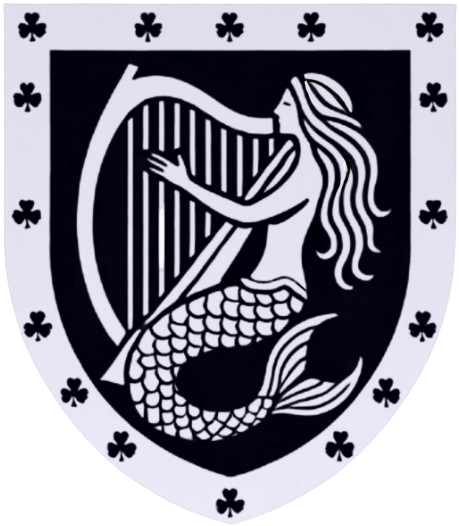
A genuine Gaelic coat of arms
Authentic Irish arms — not a "family crest" sold online
The coat of arms of Clan Ó Comáin is a genuine heraldic design drawn from the Gaelic royal tradition and recognised through the office of the Chief. It carries the mermaid of Newhall Lake, the Irish harp, and the shamrocks of the clan's patron saint, Saint Commán — the three leaves of the shamrock representing the Holy Trinity in the Gaelic Christian tradition. None of this symbolism appears on the generic "family crest" products sold online under this surname.
Under the ancient Gaelic custom of clan arms, only registered members of Clan Ó Comáin are approved by the Chief to display the arms on personal items, stationery, jewellery and ceremonial objects. The arms belong to the clan; their use is a right extended by the Chief to those whose names are entered on the Register at Newhall House.
Clan Ó Comáin — an ancient Gaelic royal house
Clan Ó Comáin is one of Ireland's recognised modern Gaelic clans, registered with Clans of Ireland under the patronage of the President of Ireland. The clan's documented historical record reaches into the 7th century, with three named Kings of the Déisi Muman across three generations. The clan's ancestral capital was Cahercommane in the Burren — a great triple-ring stone fort whose Gaelic name Cathair Commáin means "the stone fort of Commán." The modern seat is at Newhall House, County Clare.
The full documentary, archaeological, and genetic case for the clan's lineage is set out on the Pedigree page, where three independent Clare scholars have endorsed the synthesis: Rev Dr Patrick Nugent (the foremost living authority on Gaelic clans of Clare), Martin Breen (40-year historian of Clare), and Risteárd Ua Cróinín (historian to the O'Dea clan).
The Hurley family among the Kings of the Déisi Muman
The Hurley / Ó Comáin name carries into the historical record through one of the most commanding figures of 7th-century Munster. King Suibne mac Comáin of the Déisi Muman died in 658 AD, his obit preserved in the Annals of Inisfallen. His father Cobthach had ruled the same kingdom before him, dying in 632 AD. His son Congal mac Suibne, also king of the Déisi, died in 701 AD, named among the royal guarantors of the Cáin Adamnáin of 697.
Three named kings of the Déisi Muman across three generations carrying the Comán name. This is the royal inheritance that sits behind the modern Hurley surname for Munster Hurley families.
The Déisi Muman were a distinct kingdom within Munster, with their own territory, their own kings, and political weight substantial enough to appear repeatedly in the early-medieval annals. The chiefdom from which the modern clan descends, centred at Cahercommane in the Burren, was the subject of Dr David Blair Gibson's doctoral research at the University of California, Los Angeles, later expanded into From Chiefdom to State in Early Ireland (Cambridge University Press, 2012). Further evidence of the family's early-medieval reach: Colmán mac Comáin, recorded in the Annals of Inisfallen at 751 AD as a bishop of Munster and one of the four sages of Ireland, dying on the Aran Islands. His probable brother Célechair mac Commáin was killed at the battle of Corcu Modruad in 705 AD.
Welcome to every Hurley family
If you carry the surname Hurley, this clan is open to you. Clan Ó Comáin is one of Ireland's recognised Gaelic clans, with a continuous documented history reaching into the early medieval period and an active membership today drawn from every part of the world where the name has travelled. Membership is open to every Hurley family — without exception, without proof of bloodline, and without any requirement to test DNA or trace a specific parish of origin.
If your Hurley family has Munster roots, your name is most likely Ó Comáin — the same Gaelic surname that gives modern Cummins, Commons and Commane. Edward MacLysaght documented this in 1985: Ó Comáin became Hurley in parts of Munster through a 19th-century mistranslation. The Gaelic name is yours to reclaim.
Hurley is one of three distinct Gaelic surnames carried by Irish Hurley families today: Ó hUirthile, Ó Muirthile, and — in parts of Clare and Cork — Ó Comáin, misrecorded as Hurley by 18th- and 19th-century priests and clerks. All three Hurley lines are welcomed into Clan Ó Comáin. The clan does not gatekeep by surname origin. In the older Gaelic tradition, the clan was a community of shared heritage and shared loyalty, not a closed circle of provable descent.
Whatever the origin of your Hurley name, this clan is yours to join. No proof of bloodline required.
The Hurley surname in Ireland — three Gaelic origins
The Hurley surname has at least three distinct Gaelic origins in Ireland, each tracing to a different ancestral kindred:
Ó hUirthile — a native Clare and Cork Gaelic family, ancient in its own right, with documented presence across south-west Ireland.
Ó Muirthile — a related Gaelic family, also documented in Clare and Cork, with a slightly different etymology and a parallel lineage.
Ó Comáin — the Gaelic royal house behind Clan Ó Comáin, which in parts of Clare and Cork was recorded in 18th- and 19th-century parish and civil records as "Hurley" through a documented linguistic mistake.
All three are genuinely ancient Gaelic surnames. For a Hurley researcher trying to trace their family history, the question is not which origin is "better" — all three are legitimate Irish heritage — but which one applies to your particular line. The answer, in many cases, can only be established through a combination of parish records, Y-DNA testing, and family oral tradition. The clan welcomes Hurley researchers at every stage of that investigation.
How Hurley became the recorded form of Ó Comáin
For Hurley families with Munster origins, the Hurley name is the anglicised form of the Gaelic Ó Comáin. The first authoritative statement of this identity comes from Edward MacLysaght, the first Chief Herald of Ireland and the foundational authority on Irish surname history. In The Surnames of Ireland (Irish Academic Press, 1985, pp. 52–53), MacLysaght set out the linguistic mechanism with characteristic precision:
"Ó Comáin has become Hurley in some parts of Cos. Clare and Cork, due to the mistaken belief that it derives from camán, a hurley. Woulfe says it is from cam, crooked, which is equally unacceptable."
MacLysaght's point is straightforward. The Irish word camán, with a long 'á', means a hurling stick — the wooden implement of the ancient Gaelic game of hurling. The Gaelic surname Ó Comáin, pronounced similarly, descends from the entirely separate personal name Comán — a 7th-century ancestor of the Ó Comáin clan. In the 18th and 19th centuries, parish clerks, priests, and civil registrars in rural Ireland — many working without literacy in written Gaelic — recorded some Ó Comáin families as "Hurley" on the mistaken assumption that the Irish name referred to a hurley stick.
This phenomenon is known in Irish surname studies as pseudo-translation. A name is replaced not by its real meaning but by a mistaken one, based on a surface-level resemblance to an unrelated word. Pseudo-translation is one of the most common mechanisms by which Gaelic surnames were altered during the long period of anglicisation in Ireland.
Robert E. Matheson, Ireland's Registrar-General, documented a striking signature of the Hurley pseudo-translation in his 1909 report on Irish surnames:
"In the middle of a marriage certificate, there would appear such a name as Mary Hurley, while the signature would appear as Mary Commane, the latter being the Irish for hurley stick."
In other words: the priest, recording the marriage in English, wrote "Hurley". The bride herself, signing her own name, wrote "Commane". Both names appear on the same legal document — the clerical translation above, the family's own preserved form below. Where a marriage certificate, will, lease, or sworn affidavit survives with such a two-name pattern, the evidence of the Ó Comáin origin survives intact. The full context of this phenomenon is explored by Frank McNally in his piece "Synonyms of the Fathers" in The Irish Times.
Surviving evidence on the land
The pseudo-translation pattern is recorded in the landscape itself. At Ballycommane in the Civil Parish of Durrus on the Mizen Peninsula of West Cork — Gaelic Baile Uí Chomáin, "Townland of the Uí Chomáin (clan of Ó Comáin)" — the most common surname recorded in the 1901 census was Hurley. The placename kept the Gaelic original; the parish register gave the residents the mistranslated form. Same Gaelic ground, different anglicised name — a Cork demonstration of exactly what MacLysaght documented.
Was the Hurley family ever noble?
For Hurley families with Munster origins, yes. The historical evidence for noble status in the Hurley / Ó Comáin lineage is direct and well-documented. Three named Kings of the Déisi Muman across the 7th century — Cobthach (d. 632), his grandson Suibne mac Comáin (d. 658), and his great-grandson Congal mac Suibne (d. 701) — establish the family as one of the royal kindreds of early-medieval Munster. The clan held the chiefdom of Cahercommane in the Burren as its ceremonial capital from the 7th to the 9th centuries.
Following the rise of the Dál gCais — the family of Brian Boru — across Clare in the 10th and 11th centuries, the Ó Comáin clan was politically eclipsed and its territory absorbed into the new dynastic order. The lineage continued unbroken in the male line, confirmed today by Y-DNA testing, but the surface political record went quiet for several centuries. The modern Clan Ó Comáin, recognised by Clans of Ireland under the patronage of the President of Ireland, represents the formal restoration of the chiefly line.
Saint Commán — the patron of the clan
The Hurley / Ó Comáin family has a documented patron saint in the early-medieval Irish church. Saint Commán founded the monastery of Roscommon (Ros Commáin — "the wood of Commán") in the 7th century. By the 8th century the Rule of St Commán was being promulgated across Connacht as a major ecclesiastical jurisdiction. The Aran Islands carry the same name into the surviving landscape, and the church of Kinvara on the Burren shore is one of several foundations associated with the saint.
In the Gaelic Christian tradition, a patron saint anchors a clan's spiritual identity across centuries. The three-leaved shamrock that appears on the modern Clan Ó Comáin coat of arms represents the Holy Trinity — the central image of Saint Commán's ecclesiastical inheritance carried forward into the family's heraldry today.
Read the full Pedigree →
How to investigate a Hurley line
For a Hurley researcher, the question "is my family originally Ó Comáin, Ó hUirthile, or Ó Muirthile?" is one that the records can usually answer with patience. The productive research sequence is:
1. Establish your Irish origin parish. Civil registration records (searchable through irishgenealogy.ie from 1864 onwards) and the 1901 and 1911 censuses of Ireland (searchable through the National Archives of Ireland) will usually place an Irish-born Hurley ancestor in a specific parish. The parish of origin is the single most useful clue.
2. Search for parallel spellings in the same parish. Search the Tithe Applotment Books (1820s–40s), Griffith's Valuation (1847–64), and Catholic parish registers for Commane, Cummane, Cummins, Commons, Commins, Comyn, or Ó Comáin entries in the same parish — particularly in the generations before the earliest Hurley appearance. If both spellings appear, that is strong evidence.
3. Look for two-name documents. Marriage certificates, wills, and civil affidavits sometimes preserve both the priest's translation and the family member's own signature. These are effectively conclusive when found.
4. Test Y-DNA where possible. A Big-Y-700 test through Family Tree DNA's Big Y project will place a male-line Hurley definitively within or outside the Ó Comáin terminal haplogroup (R-BY14247).
5. Read the primary genealogical literature. Edward MacLysaght's The Surnames of Ireland (1985) remains the authoritative reference. Frank McNally's Irish Times piece "Synonyms of the Fathers" is an excellent accessible introduction to pseudo-translation in Irish surname history.
Get the free Hurley research guide →
What Y-DNA testing can tell a Hurley family
Y-DNA testing is the most powerful tool available to a Hurley researcher who wants to clarify which Gaelic origin their family carries. Where the documentary record has been altered by centuries of mistranslation, DNA has not: a male-line Hurley either does or does not share a recent common male-line ancestor with the documented Ó Comáin pedigree.
The Ó Comáin male line carries terminal Y-haplogroup R-BY14247, within the broader R-L21 Celtic group — the defining genetic marker of the Celtic peoples of Ireland, Scotland, Wales and Brittany. The line sits on the deep R-Z2534 Munster substrate, with ancient Irish origins. Critically, the line tests negative for the R-L226 marker that defines the Dál gCais — the dynasty of Brian Boru and the O'Briens of Thomond — confirming the Ó Comáin line as biologically distinct from the Dalcassian dynasty.
For a Hurley researcher, the implication is simple. A male-line Hurley whose test places them within R-BY14247 is, genetically, descended from the Ó Comáin lineage — whatever the 19th-century parish records say. A Hurley whose test places them outside R-BY14247 has almost certainly descended from one of the other Gaelic origins (Ó hUirthile or Ó Muirthile). Both outcomes are genealogically valuable. Both restore clarity where paper records cannot.
Big-Y-700 testing through Family Tree DNA is the gold standard. An autosomal test (Ancestry, 23andMe, MyHeritage) will confirm broad Irish ancestry but does not reach surname-specific depth. Only Y-DNA follows the direct male line across the centuries of anglicisation, mistranslation, and emigration.
Hurley families in the Irish diaspora
For Hurley families in the United States, Canada, Australia, New Zealand, and Britain, the question of Gaelic origin is typically one generation further removed from the source. Families emigrating from Ireland in the 19th century carried the Hurley surname into the new country and preserved it, often never realising that a great-grandparent might have been recorded as Commane or Ó Comáin a generation or two earlier.
American Hurley families are documented in the emigration and naturalisation records of the 1840s onward, settling first in Boston, New York, and Philadelphia, and later in the Midwest as Irish settlement extended westward. Canadian Hurley families appear in the 19th-century immigration ledgers at Grosse Île and other ports of entry. Australian Hurley families arrived through the assisted-emigrant schemes of the 1840s and 1850s. British Hurley families concentrated in Liverpool, Manchester, Glasgow and London, often arriving via the Famine-era migration routes.
Wherever a Hurley family has settled, the clan extends welcome. Membership is open to Hurley families in every country — connecting you to the wider community of Ó Comáin clan members worldwide, and to the documented Gaelic heritage that the Hurley name carries forward.
Joining Clan Ó Comáin as a Hurley family
Clan Ó Comáin welcomes every Hurley family — whether the Ó Comáin origin is confirmed by DNA, documented by family oral tradition, suggested by parish records, or carried forward simply by inheritance of the Hurley name. In the Gaelic tradition under Brehon law, the clan was never strictly about bloodline. A clan was a living association of families bound by shared history, shared landscape, and shared duty.
Membership brings:
— A recognised place in the Register of Members at Newhall House, County Clare.
— Permission, under the ancient Gaelic custom of clan arms, to display the Clan Ó Comáin coat of arms on personal items and stationery.
— Access to the Members' Library — including the full scholarly Y-DNA white paper, primary-source manuscripts, and ongoing research updates.
— Connection to the worldwide community of Clan Ó Comáin members across the Irish diaspora.
— Standing recognition of your family within one of Ireland's officially recognised Gaelic clans.
Frequently asked questions
Is Hurley an Irish surname?
Yes. Hurley is one of Ireland's most enduring Gaelic surnames, carried by Irish families since the medieval period. It has three distinct Gaelic origins: Ó hUirthile (a native Clare and Cork family), Ó Muirthile (a related Gaelic family of the same region), and — in parts of Clare and Cork — Ó Comáin, misrecorded as Hurley through a documented linguistic mistake in the 18th and 19th centuries.
What does Hurley mean in Irish?
Hurley, as the pseudo-translated form of Ó Comáin, means "descendant of Comán" — the same Gaelic root that gives Cummins, Commins, Commons, and Commane. It does not mean "hurling stick" despite the surface resemblance to camán, which is what caused the mistranslation in the first place.
Is every Hurley family from Ó Comáin?
No. Most Hurley families in Ireland descend from Ó hUirthile or Ó Muirthile — separate, genuinely ancient Gaelic lines. Only a portion of Hurley families from Clare and Cork carry the Ó Comáin origin through pseudo-translation. Clan Ó Comáin welcomes all three groups equally.
How can I tell if my Hurley family is originally Ó Comáin?
Several clues together make the Ó Comáin origin more likely: (1) family origins in Clare or Cork, (2) older records in the same parish using Commane, Cummins, Comyn or similar spellings, (3) two-name documents (such as a marriage certificate where the priest wrote "Hurley" but the family member signed "Commane"), and (4) Y-DNA testing showing the R-BY14247 terminal haplogroup.
Can I join Clan Ó Comáin if my surname is Hurley?
Yes. Clan Ó Comáin welcomes every Hurley family — whether the Ó Comáin origin is confirmed by DNA, documented by family oral tradition, or whether the family descends from one of the other Gaelic Hurley origins (Ó hUirthile, Ó Muirthile). Membership is open to all bearers of the Hurley name regardless of which Gaelic origin your family carries.
What does R-BY14247 mean?
R-BY14247 is the terminal Y-DNA haplogroup of the documented Ó Comáin male line, confirmed by Big-Y-700 testing through Family Tree DNA. It sits within the wider R-L21 Celtic group on the R-Z2534 Munster substrate. A male-line Hurley who tests within R-BY14247 is, genetically, descended from the Ó Comáin lineage — whatever the 19th-century parish records happen to say.
Was the Hurley family ever noble?
For Hurley families with Munster origins, yes. Three named Kings of the Déisi Muman in the 7th century — Cobthach (d. 632), his grandson Suibne mac Comáin (d. 658), and his great-grandson Congal mac Suibne (d. 701) — establish the Hurley / Ó Comáin family as one of the royal kindreds of early-medieval Munster. The clan held the chiefdom of Cahercommane in the Burren as its ceremonial capital from the 7th to the 9th centuries.
Where is Cahercommane and can I visit it?
Cahercommane is a triple-ring stone fort on the south-eastern edge of the Burren in County Clare, about 8km from Newhall House. The site is publicly accessible and free to visit. It is the ancestral capital of Clan Ó Comáin and one of the most important early-medieval sites in Munster.
Is Clan Ó Comáin officially recognised?
Yes. Clan Ó Comáin is registered with Clans of Ireland under the patronage of the President of Ireland. The clan's seat is at Newhall House, County Clare. Three independent Clare scholars have endorsed the documented Pedigree: Rev Dr Patrick Nugent (the foremost living authority on Gaelic clans of Clare), Martin Breen (40-year historian of Clare), and Risteárd Ua Cróinín (historian to the O'Dea clan).
Apply for Hurley / Ó Comáin clan membership