Ó Comáin
A genuine Gaelic coat of arms
Authentic Irish arms — not a "family crest" sold online
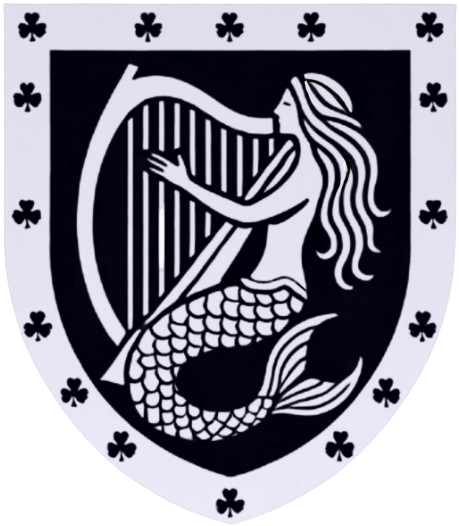
The coat of arms of Clan Ó Comáin is a genuine heraldic design drawn from the Gaelic royal tradition and recognised through the office of the Chief. It carries the mermaid of Newhall Lake, the Irish harp, and the shamrocks of the clan's patron saint, Saint Commán — the three leaves of the shamrock representing the Holy Trinity in the Gaelic Christian tradition. None of this symbolism appears on the generic "family crest" products sold online under this surname.
Under the ancient Gaelic custom of clan arms, only registered members of Clan Ó Comáin are approved by the Chief to display the arms on personal items, stationery, jewellery and ceremonial objects. The arms belong to the clan; their use is a right extended by the Chief to those whose names are entered on the Register at Newhall House.
Important distinction
If your Cummins family is Irish, you are in the right place.
There are two entirely different clans that people sometimes confuse because their names look and sound similar in English:
Irish — this clan
Clan Ó Comáin
Gaelic royal house of County Clare and Munster. Name descends from the Irish personal name Comán. First documented king: Suibne mac Comáin, rí na nDéisi, died 658 AD. Ancestral capital: Cahercommane in the Burren. Modern surnames include Cummins, Cummings, Cumming, Commins, Commons, Commane, Comyn, Hurley.
Scottish — separate clan
Clan Cumming / Comyn
Norman-Scottish house descended from the de Comines family of Flanders. Arrived in Scotland with the 12th-century Anglo-Norman nobility. Their blue-and-gold wheat-sheaves coat of arms is the one most commonly sold online under "Cummins family crest" — but it is not Irish and has no documented connection to the Gaelic Ó Comáin.
The phonetic similarity is a centuries-old coincidence, not a connection. Edward MacLysaght — the first Chief Herald of Ireland — documented this in The Surnames of Ireland (1985): the Irish name is Ó Comáin, distinct in origin from the Scots-Norman house. A few spellings — Cumming, Comyn, even Cummings — are shared by both, reached independently in each country. So the spelling alone cannot tell you which clan you descend from; it is origin and lineage that decide it.
If your Cummins ancestors came from Ireland — Clare, Cork, Tipperary, Galway, Roscommon, Wexford, Kerry, anywhere on the island — you most likely descend from Clan Ó Comáin. Most anglicised spellings in the Cummins / Commins / Commons / Commane family belong to this Gaelic lineage, and membership is open to you. A small number of Comyn families in Ireland do descend from the Scottish-Norman line — particularly in parts of Ulster and along the medieval Anglo-Norman seaboard — and we acknowledge that distinction openly.
Where does the Cummins name come from?
The surname Cummins is the most common anglicised form of the ancient Irish Gaelic name Ó Comáin — meaning descendant of Comán. In the Griffiths Valuation of Ireland (1847–1864), the largest single survey of Irish households ever conducted, Cummins was recorded as the largest variant of the name with 843 families — outnumbering Commons (360), Commins (150), Cummane (22) and Commane (8) combined.
Today the surname is ranked 259th in Ireland, with roughly 7,500 to 15,000 people carrying the name. In the United States, Cummins expanded by 433 percent between 1880 and 2014, driven by the Famine emigration of the 1840s and 1850s when Clare and Munster families landed in Boston, New York, Chicago and beyond.
The name is concentrated in Munster and Connacht, particularly Counties Clare, Cork and Tipperary. That is not coincidence. These are the ancestral territories of Clan Ó Comáin, the ancient Gaelic family from whose name Cummins directly descends.
What the First Chief Herald of Ireland said about Cummins
The most authoritative statement on the Irish origin of the Cummins name comes from Edward MacLysaght, the first Chief Herald of Ireland, in Irish Families: Their Names, Arms and Origins (Irish Academic Press, revised edition 1972, p.103) — where he set out the family's origins in unusually full terms:
"Notwithstanding its very English appearance Cummins is a Gaelic Irish surname quite distinct from the English Cummings and Cumming, though sometimes the original Ó Coimín takes those forms as its anglicised synonyms… Ó Coimín is first found in Connacht: the family were erenaghs of the church of St Cuimín Fada, and the parish of Kilcummin on the western side of the Bay of Killala is named after them… It appears as Ó Comáin in Munster, whence come the majority of present day Cumminses (also called Commane) now found in Counties Tipperary and Cork. There they are sometimes called Hurley, through a mistranslation, camán being the Gaelic word for a hurley-stick."
MacLysaght was explicit. In Munster, Cummins is Ó Comáin — and Munster Ó Comáin is the source of the majority of present-day Cumminses. Not a Scots-Norman name. Not an English name. An ancient Gaelic name from one of the oldest documented clan territories in Ireland.
The standardised Irish-language form of the name, under An Caighdeán Oifigiúil (1958) — the Irish State's official standard for the Irish language — is Ó Comáin. MacLysaght and the standard onomastic authorities trace the many Gaelic and anglicised variants — Ó Coimín, Cummins, Cummings, Commons, Commins, Commane — back to this single Gaelic root.
The ancient lineage behind the Cummins name
The ancestor who gives the Cummins surname its meaning is Coman mac Breanan Dall, who lived around 620–650 AD. He was the son of Breanan Dall, 12th King of Uí Maine, whose death is recorded in the Annals of Ulster at 597 or 601 AD. That makes Breanan the earliest individually named direct ancestor of the Cummins family in any primary historical source.
From Coman, the surname Ó Comáin — descendant of Coman — was born. Over subsequent centuries, under the pressure of anglicisation, tax rolls, census records and clerical misrecording, it became Cummins, Commons, Commins, Commane, and dozens of other forms. But the origin is one. An ancient Gaelic name of a County Clare clan.
The lineage extends further back. Through the genealogical records preserved in the great medieval Irish manuscript tradition, and John O'Hart's Irish Pedigrees (1892), the clan traces royal descent through the Kings of Uí Maine to Cairbre Crom, 11th King of Uí Maine (fl. c. 556 AD). That ancestral figure is shared by the Cummins / Ó Comáin family and many of the great Gaelic dynasties of Clare and Connacht, including the Kelly, Clancy, Madden and Tracy families.
The Cummins family among the Kings of the Déisi Muman
Beyond the Uí Maine royal line in Connacht, the Comán name carries into the historical record through one of the most commanding figures of 7th-century Munster. King Suibne mac Comáin of the Déisi Muman died in 658 AD, his obit preserved in the Annals of Inisfallen. His father Cobthach had ruled the same kingdom before him, dying in 632 AD. His son Congal mac Suibne, also king of the Déisi, died in 701 AD, named among the royal guarantors of the Cáin Adamnáin of 697.
Three named kings of the Déisi Muman across three generations carrying the Comán name. This is the inheritance that sits behind the modern Cummins surname.
The Déisi Muman were a distinct kingdom within Munster — with their own territory, their own kings, and political weight substantial enough to appear repeatedly in the early-medieval annals. The chiefdom from which the modern clan descends, centred at Cahercommane in the Burren, was the subject of Dr David Blair Gibson's doctoral research at the University of California, Los Angeles, later expanded into From Chiefdom to State in Early Ireland (Cambridge University Press, 2012).
Further evidence of the family's early-medieval reach: Colmán mac Comáin, recorded in the Annals of Inisfallen at 751 AD as a bishop of Munster and one of the four sages of Ireland, dying on the Aran Islands. His probable brother Célechair mac Commáin was killed at the battle of Corcu Modruad in 705 AD. The full scholarly evidence is set out on the Pedigree page — including the Gibson chiefdom analysis, the Pender Déisi Genealogies, the Annals citations across multiple traditions, and the Y-DNA confirmation.
Cahercommane — the ancestral capital of the Cummins clan
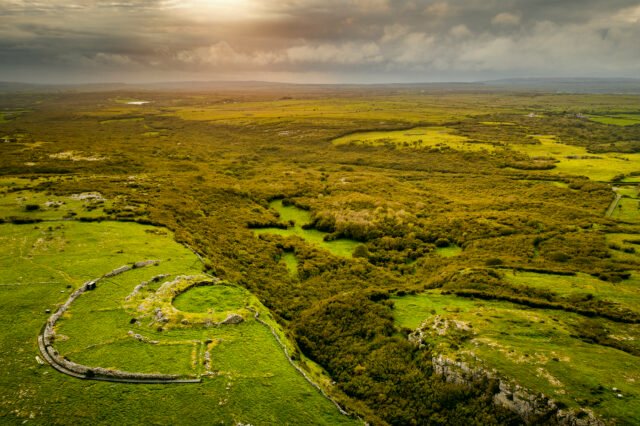
In the Burren of County Clare stands one of the most remarkable early medieval sites in Ireland. Cahercommane — meaning the stone fort of Commán — is a great triple-ring stone fort built in the 8th–9th century on the cliff edge of the Burren. It was the ceremonial capital and inauguration site of the Chiefdom of Tulach Commáin, whose descendants carry the Cummins name today.
Hugh O'Neill Hencken excavated the site for the Harvard Archaeological Expedition in 1934, and the Discovery Programme has carried out detailed reassessment in 1999 and 2012 under Claire Cotter. The inner wall alone used an estimated 16,500 tons of stone. Cahercommane is regarded by historians as one of the most important early medieval sites in Munster — the physical embodiment of the Cummins family name and a monument to the chiefdom from which the surname descends.
The site sits on the south-eastern edge of the Burren in County Clare, about 8km from Newhall House, the seat of the living Chief of Ó Comáin, Fergus Kinfauns, The Commane. Cahercommane is publicly accessible and free to visit, preserving the connection between the modern clan and the landscape from which its name and identity emerged.
Was the Cummins family ever noble?
Yes. The historical evidence for noble status in the Cummins / Ó Comáin lineage is direct and well-documented. Three named Kings of the Déisi Muman across the 7th century — Cobthach (d. 632), his grandson Suibne mac Comáin (d. 658), and his great-grandson Congal mac Suibne (d. 701) — establish the family as one of the royal kindreds of early-medieval Munster. The descent through Cairbre Crom and the Kings of Uí Maine into the Connacht royal line is preserved in the medieval manuscript tradition. The clan held the chiefdom of Cahercommane in the Burren as its ceremonial capital from the 7th to the 9th centuries.
Following the rise of the Dál gCais — the family of Brian Boru — across Clare in the 10th and 11th centuries, the Ó Comáin clan was politically eclipsed and its territory absorbed into the new dynastic order. The clan's documented chiefly succession in the Connacht record ends around 1225, at the moment of Anglo-Norman dispossession. The lineage continued unbroken in the male line, confirmed today by Y-DNA testing, but the surface political record went quiet for several centuries. That is the standard pattern for pre-Dalcassian Munster kindreds.
The modern Clan Ó Comáin, recognised by Clans of Ireland under the patronage of the President of Ireland, represents the formal restoration of the chiefly line. The seat is at Newhall House, County Clare, under the current Chief.
Saint Commán — the patron of the clan
The Cummins / Ó Comáin family has a documented patron saint in the early-medieval Irish church. Saint Commán founded the monastery of Roscommon (Ros Commáin — "the wood of Commán") in the 7th century. By the 8th century the Rule of St Commán was being promulgated across Connacht as a major ecclesiastical jurisdiction. The Aran Islands carry the same name into the surviving landscape, and the church of Kinvara on the Burren shore is one of several foundations associated with the saint.
In the Gaelic Christian tradition, a patron saint anchors a clan's spiritual identity across centuries. The three-leaved shamrock that appears on the modern Clan Ó Comáin coat of arms represents the Holy Trinity — the central image of Saint Commán's ecclesiastical inheritance carried forward into the family's heraldry today.
Cummins in America and the diaspora
In the Griffiths Valuation of 1855, John Commane — a tenant farmer in Ballyea townland, Killone parish, County Clare — is the last recorded holder of the name in that location before the Famine. He is absent from subsequent records, almost certainly a victim of the Great Famine of 1845–1852 or one of the hundreds of thousands who emigrated to America in those years.
Today Cummins is the 1,443rd most popular surname in the United States, with an estimated 22,383 people carrying the name — four times as many as in Ireland. Commane Road in Baldwinsville, New York (Onondaga County) testifies to the Famine-era emigration of the family to upstate New York, where the name became embedded in the American landscape just as it had once been embedded in Clare.
The Cummins diaspora is concentrated in cities that received heavy Munster Irish emigration in the 1840s and 1850s. Boston, New York, Philadelphia, and the industrial cities of the Northeast carried the first wave. Chicago and the Midwest saw later settlement as Irish families moved inland. Australian Cummins families arrived through the assisted-emigrant schemes of the 1840s and 1850s. British Cummins families concentrated in Liverpool, Manchester, Glasgow and London, often arriving via the pre-Famine and Famine-era migration routes.
Place-names across Ireland itself preserve the family's deeper Munster reach. Commane Road in Cork, the townland of Na Comáin ("the Commanes") in Kerry's Iveragh barony, and Ballycommane (Baile Uí Chomáin, "Townland of the Uí Chomáin") in West Cork all mark the landscape where the family was once a recognised presence.
What about the Cummins coat of arms?
If you have searched online for a Cummins coat of arms, you will almost certainly have found websites selling prints bearing a blue and gold shield with wheat sheaves. These are not authentic arms for the Irish Cummins family. They are the arms of the Scottish-Norman House of Comyn, a completely separate dynasty descended from the de Comines family of Flanders, with no documented connection to the Gaelic Ó Comáin clan.
The confusion arose because the names sounded similar to English-speaking officials from the 16th century onward, who wrote "Comyn" when they heard "Comáin." Commercial heraldry companies then assigned the well-known Norman Comyn arms to everyone bearing any phonetically similar name, including Cummins. It is a centuries-old error that has been sold to millions of Irish-American families.
A formal grant of authentic Gaelic arms is being prepared through the Office of the Chief Herald of Ireland — the first formal heraldic identity for the Gaelic sept, grounded in one of the most thoroughly researched pedigrees presented to the Chief Herald's office in recent years. When granted, the new arms will be available to all registered members of Clan Ó Comáin.
Read the full coat of arms story →
DNA confirms an ancient Irish origin
Big-Y DNA testing of the chief's male line confirms the Cummins / Ó Comáin patriline as an ancient Irish line on the deep Munster substrate carried by multiple Gaelic kindreds of the south-west. Critically, the line tests negative for the genetic marker that defines the Dál gCais — the family of Brian Boru and the O'Briens of Thomond — confirming Ó Comáin as a separate Gaelic line, not a branch of the later Dalcassian dynasty.
The closest match on the FamilyTreeDNA database is to a Moylan tester from north Clare, consistent with the clan's documented Burren origins. The full scholarly Y-DNA white paper — including the complete haplogroup chain, the FamilyTreeDNA match cluster, and the Big-Y dating analysis — is available in the members' library once you join.
Frequently asked questions
Is Cummins an Irish name?
Yes. In Ireland, Cummins is the anglicised form of the Gaelic Ó Comáin — a County Clare clan name documented since 658 AD. Edward MacLysaght, the first Chief Herald of Ireland, confirmed that Cummins in Munster derives directly from Ó Comáin. The name is ranked 259th in Ireland today.
What clan does Cummins belong to?
Irish Cummins families belong to Clan Ó Comáin — an ancient Gaelic clan from County Clare, recognised by Clans of Ireland under the patronage of the President of Ireland. The clan's ancestral capital, Cahercommane in the Burren, bears the clan name to this day. Membership is open to all Cummins families and all who love Irish and Gaelic culture.
Was the Cummins family ever noble?
Yes. Three named Kings of the Déisi Muman in the 7th century — Cobthach (d. 632), his grandson Suibne mac Comáin (d. 658), and his great-grandson Congal mac Suibne (d. 701) — establish the Cummins / Ó Comáin family as one of the royal kindreds of early-medieval Munster. The clan held the chiefdom of Cahercommane in the Burren as its ceremonial capital from the 7th to the 9th centuries.
Is the Cummins coat of arms sold online authentic?
No. The coat of arms sold commercially for Cummins — typically blue and gold wheat sheaves — belongs to the Scottish-Norman House of Comyn, not the Gaelic Irish Ó Comáin clan. A formal grant of authentic Gaelic arms is being prepared through the Office of the Chief Herald of Ireland.
Where in Ireland do Cummins families originate?
The Cummins name is predominantly found in Munster — particularly Counties Clare, Cork and Tipperary. The ancestral heartland of Clan Ó Comáin is the Burren of County Clare, where Cahercommane (the stone fort of Commán) was the ceremonial capital of the chiefdom from the 8th century onward.
Is Irish Cummins the same as Scottish Clan Cumming or Comyn?
No — they are two separate clans. Irish Cummins descends from the Gaelic Ó Comáin, an ancient royal house of County Clare and Munster with first named king Suibne mac Comáin (d. 658 AD, Annals of Inisfallen) and ancestral capital at Cahercommane. Scottish Clan Cumming is a Norman house descended from the de Comines family of Flanders, arriving in Scotland with the 12th-century Anglo-Norman nobility. If your Cummins ancestors came from Ireland, you most likely belong to Clan Ó Comáin — though a small number of Comyn families in Ireland, particularly in parts of Ulster, do descend from the Scottish-Norman line.
Are the Cummins family related to the Brian Boru O'Briens?
No. Y-DNA testing has confirmed the Cummins / Ó Comáin line as genetically distinct from the Dál gCais (the family of Brian Boru). The two families both descend from the deep Munster substrate, but on separate branches. The Ó Comáin clan pre-dates the Dál gCais rise in Clare by several centuries.
Where is Cahercommane and can I visit it?
Cahercommane is a triple-ring stone fort on the south-eastern edge of the Burren in County Clare, about 8km from Newhall House. The site is publicly accessible and free to visit. It is the ancestral capital of Clan Ó Comáin and one of the most important early-medieval sites in Munster.
Are Cummins and Hurley the same family?
In some cases, yes. In parts of Counties Clare and Cork, the name Ó Comáin was anglicised as Hurley through pseudo-translation — priests mistakenly believed the name derived from camán, a hurling stick. MacLysaght documented this explicitly. These Hurley families share the same Ó Comáin ancestry as Cummins families from the same areas.
Apply for Cummins clan membership